

THE ADVISORY PULSE
By Dr. Suliman E. Ahmed
Founder & CEO, Dr. Suliman Advisory Group (DSAG)
Editor’s Note: This article appears, in expanded form, in Dr. Suliman Elwagei Ahmed’s forthcoming book, The DSAG Executive Methodology (Founder’s Edition), coming soon on Amazon. Join the early launch list.

One of the most common mistakes young leaders make is believing that confronting every challenge simultaneously is a sign of strength.
It is not.
In reality, effective leadership is not measured by how many battles you engage in, but by how wisely you choose which battle deserves your full attention first.
Strong leaders do not retreat from challenges.
They reorganize them.
They separate competing priorities, establish a strategic sequence, and address each challenge according to its long-term impact rather than its immediate visibility.
I learned this lesson more than a decade ago during my pediatric internship in Riyadh.
At the time, I was balancing two significant objectives.
The first was completing my clinical internship training successfully.
The second, and arguably more important for my long-term aspirations, was mastering English and preparing for the IELTS examination in the Diplomatic Quarter to build an international pathway toward graduate education, whether through a Master’s degree or a Master of Public Health program.
My goal was never simply to complete internship training.
I was building a future.
As a result, during my first month in the pediatrics department, my attention was divided.
One pediatric consultant interpreted my situation very differently.
In his view, I appeared disengaged.
Every morning presentation was heavily scrutinized.
Every case discussion was challenged with detailed questions.
During clinical rounds, feedback was often delivered publicly and with little margin for error.
At the time, it felt like a confrontation.
What he could not see was that I was not avoiding responsibility.
I was solving a different problem first.
Looking back, however, I realized the consultant was not entirely wrong.
My performance had indeed been affected by competing priorities.
At the time, I viewed the situation solely through the lens of my intentions. I knew I was working relentlessly toward a larger goal and building an international pathway for my future. What I failed to appreciate was that leaders are judged not by their intentions, but by what others can reliably observe.
I had managed my schedule, but I had not managed perceptions.
Leaders who choose to prioritize one objective over another must communicate that choice clearly, otherwise strategic focus may be mistaken for disengagement.
The consultant could only evaluate what he saw in front of him. From his perspective, my level of engagement did not yet reflect my full potential.
In retrospect, that lesson proved nearly as valuable as the IELTS score itself.
Leadership is not only about managing priorities.
It is also about communicating them effectively.
Once I completed my IELTS preparation and achieved the score required for international university applications, my priorities shifted completely.
My focus returned fully to pediatrics.
I began presenting cases entirely from memory, from history through management plan, without relying on notes.

My project presentations gained recognition, and consultants eventually asked me to participate in educational and audit sessions for junior trainees.
By the end of the rotation, I had received at least five recommendation letters from the pediatric department.
Most notably, the same consultant who had initially been the most critical became one of the strongest advocates for my performance and development.
That experience shaped a leadership lesson I continue to share with executives, founders, and healthcare leaders today.
Leadership is not about proving yourself every moment.
Leadership is understanding which challenge must be solved first.
Weak leaders attempt to fight every battle simultaneously.
Effective leaders deconstruct pressure, sequence priorities, and return to each challenge with full presence when the time is right.
Over the years, this principle evolved into a framework I now use to help leaders evaluate focus, pressure, and execution:
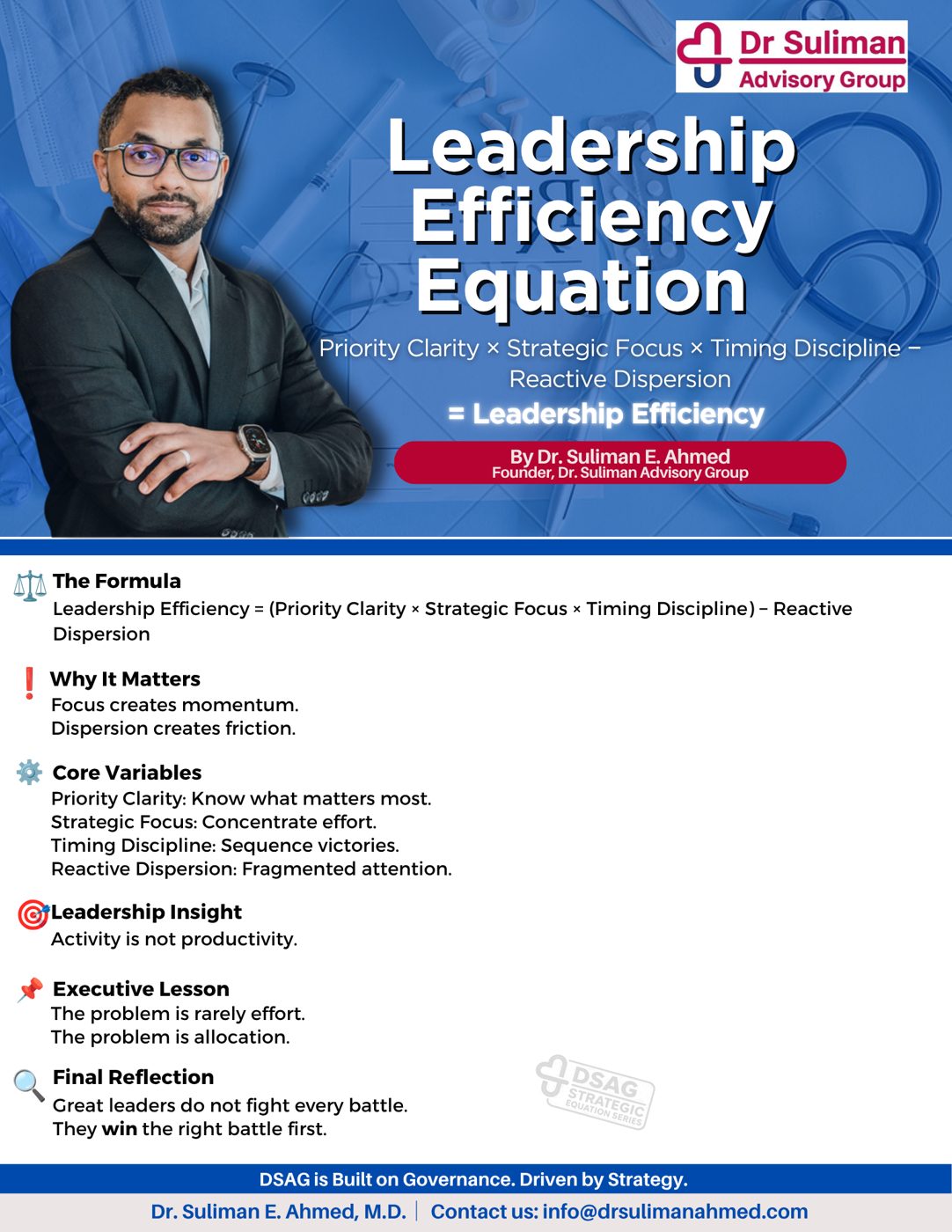
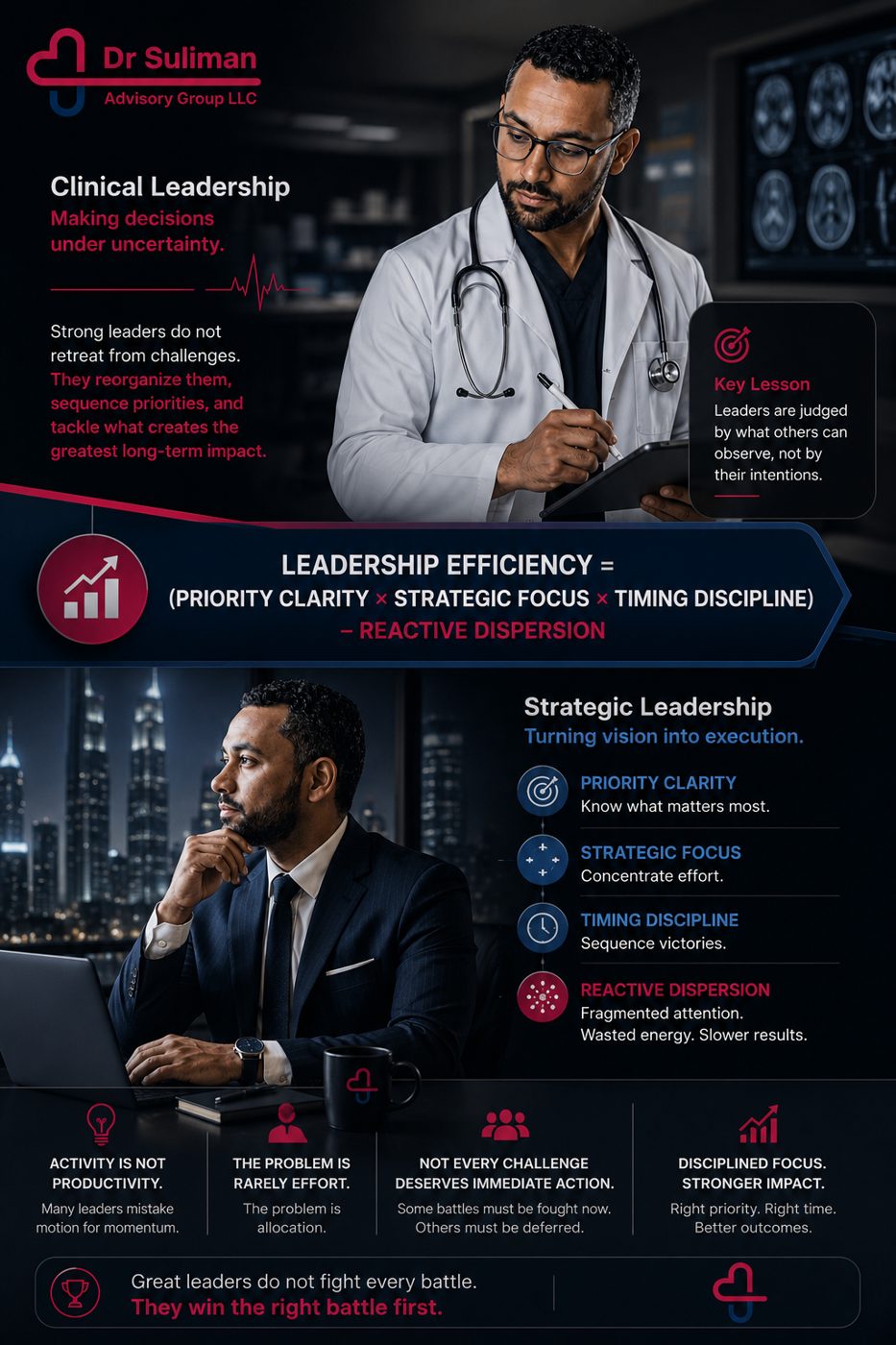
Leadership Efficiency = (Priority Clarity × Strategic Focus × Timing Discipline) − Reactive Dispersion
This is a conceptual model for thinking about focus and sequencing, not a formula to calculate.
The most overlooked variable is Reactive Dispersion.
Reactive Dispersion represents the loss of energy, attention, and execution quality that occurs when leaders attempt to solve every problem at the same time without strategic prioritization.
Many leaders mistakenly view activity as progress.
They equate motion with momentum.
But sustainable performance rarely comes from doing more.
It comes from concentrating effort where it creates the greatest leverage.
When performance begins to decline, leaders should ask four simple questions:
• Is the priority clear?
• Is focus fragmented?
• Is the timing appropriate?
• What sources of Reactive Dispersion are consuming attention?
More often than not, the problem is not effort.
The problem is allocation.
The consequences of Reactive Dispersion commonly include:
• Fragile decision-making under pressure
• Fragmented attention across teams and priorities
• Slower execution disguised as productivity
• Burnout resulting from constant context switching
Research on task switching supports this: each switch between tasks carries a measurable cost in time and accuracy, and those costs add up as switching becomes more frequent (Rubinstein, Meyer, & Evans, 2001).
Organizations rarely fail because leaders lack effort.
More often, they fail because effort becomes fragmented across too many competing priorities.
The ultimate discipline of leadership is distinguishing between what is urgent and what is consequential.
Great leaders understand that not every challenge deserves immediate action.
Some battles must be fought now.
Others must be deliberately deferred.
What often appears to outsiders as momentum is rarely the result of doing everything at once.
More often, it is the result of disciplined focus applied in the right order.
Leadership excellence emerges from having the wisdom to postpone the second battle until the first has been decisively won.
Not every moment deserves your full energy.
But every stage of growth deserves your full awareness.
Dr. Suliman E. Ahmed, M.D.
Founder & CEO, Dr. Suliman Advisory Group
The Advisory Pulse
Reference
Rubinstein, J. S., Meyer, D. E., & Evans, J. E. (2001). Executive control of cognitive processes in task switching. Journal of Experimental Psychology: Human Perception and Performance, 27(4), 763–797.