THE ADVISORY PULSE
By Dr. Suliman E. Ahmed
Founder & CEO, Dr. Suliman Advisory Group (DSAG)
Editor’s Note: This article introduces selected concepts from Dr. Suliman Elwagei Ahmed’s forthcoming book on evidence-based strategic leadership and organizational growth.
Executive Summary
Why One Great Day Means Little, and Your Average Means Everything
Introduction
Most people judge themselves by their best day or their worst day.
A brilliant presentation convinces us we have arrived. A difficult week convinces us we are falling behind.
Both conclusions are usually wrong.
From an evidence-based perspective, a single result tells us very little about who we are. What tells us almost everything is our average.
The Lesson from Thinking, Fast and Slow
In Thinking, Fast and Slow (2011), Nobel laureate Daniel Kahneman describes a phenomenon that quietly shapes every performance review, every career, and every organization: regression to the mean.
Kahneman recalls working with flight instructors in the Israeli Air Force. One instructor insisted that praise made cadets worse and criticism made them better. When he praised an excellent landing, the next landing was usually worse. When he criticized a poor one, the next was usually better.
Kahneman’s explanation was simple and powerful. The instructor was not observing the effect of praise or criticism. He was observing chance. An unusually good landing is partly luck, so the next attempt naturally drifts back toward the cadet’s real average. The same is true for an unusually poor one.
Kahneman summarized the idea in two short formulas:
Success = talent + luck
Great success = a little more talent + a lot of luck
Kahneman’s point was a warning: we routinely mistake chance for cause, crediting our praise, our criticism, or our talent for results that luck largely produced.
That insight leads to a practical conclusion for leaders. Spikes and drops are not identity. They are noise around a mean. And if single results are mostly noise, the only thing worth building is the mean itself.
The Raise Your Mean Equation
Every one of us has an average level of performance: in how we think, how early we wake up, and how we show up at work, at the gym, and at home.
Some days we rise because someone inspires us. Some days we fall because of pressure, illness, or extra commitments. Over a week, a month, or an entire project, we return to that average.
This leads to the first equation:
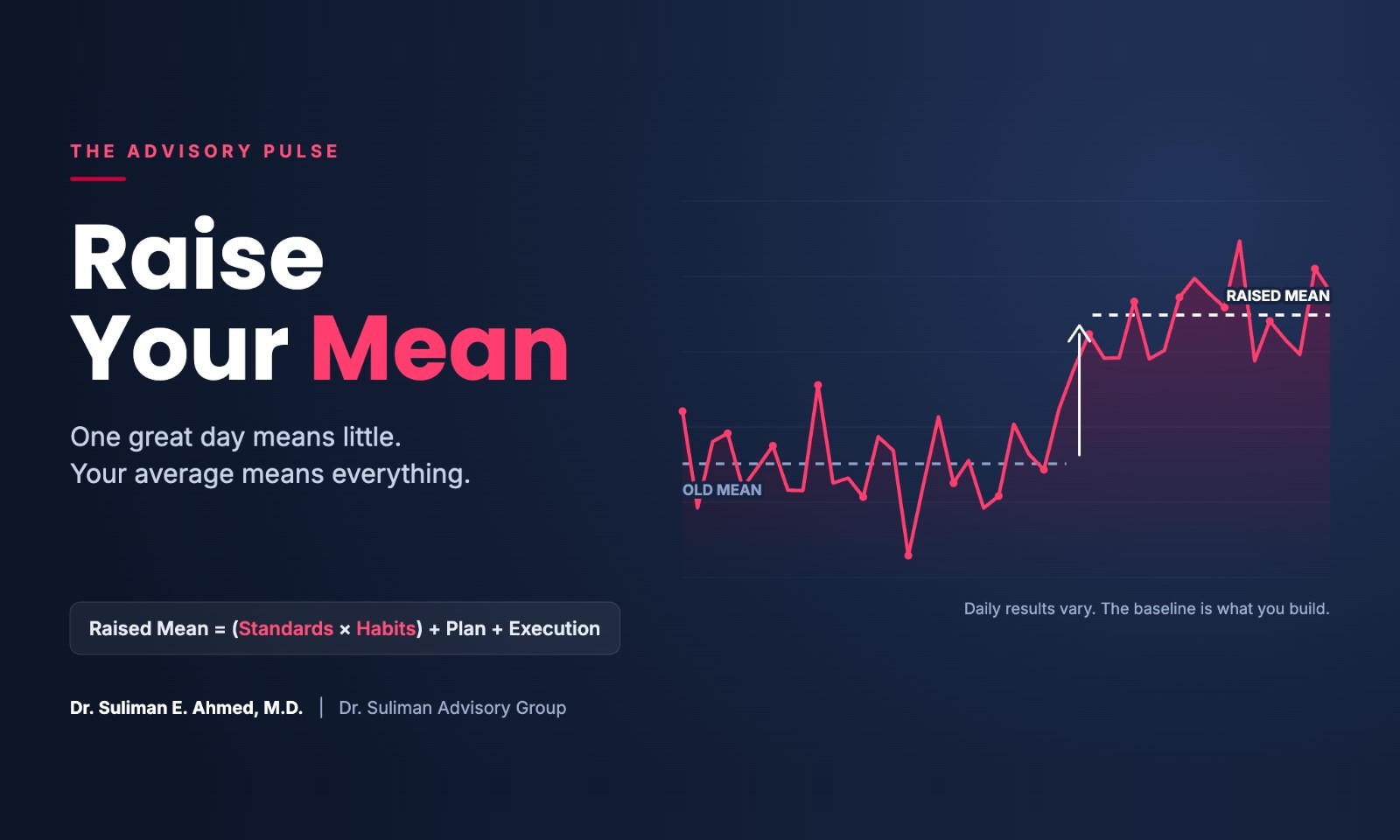
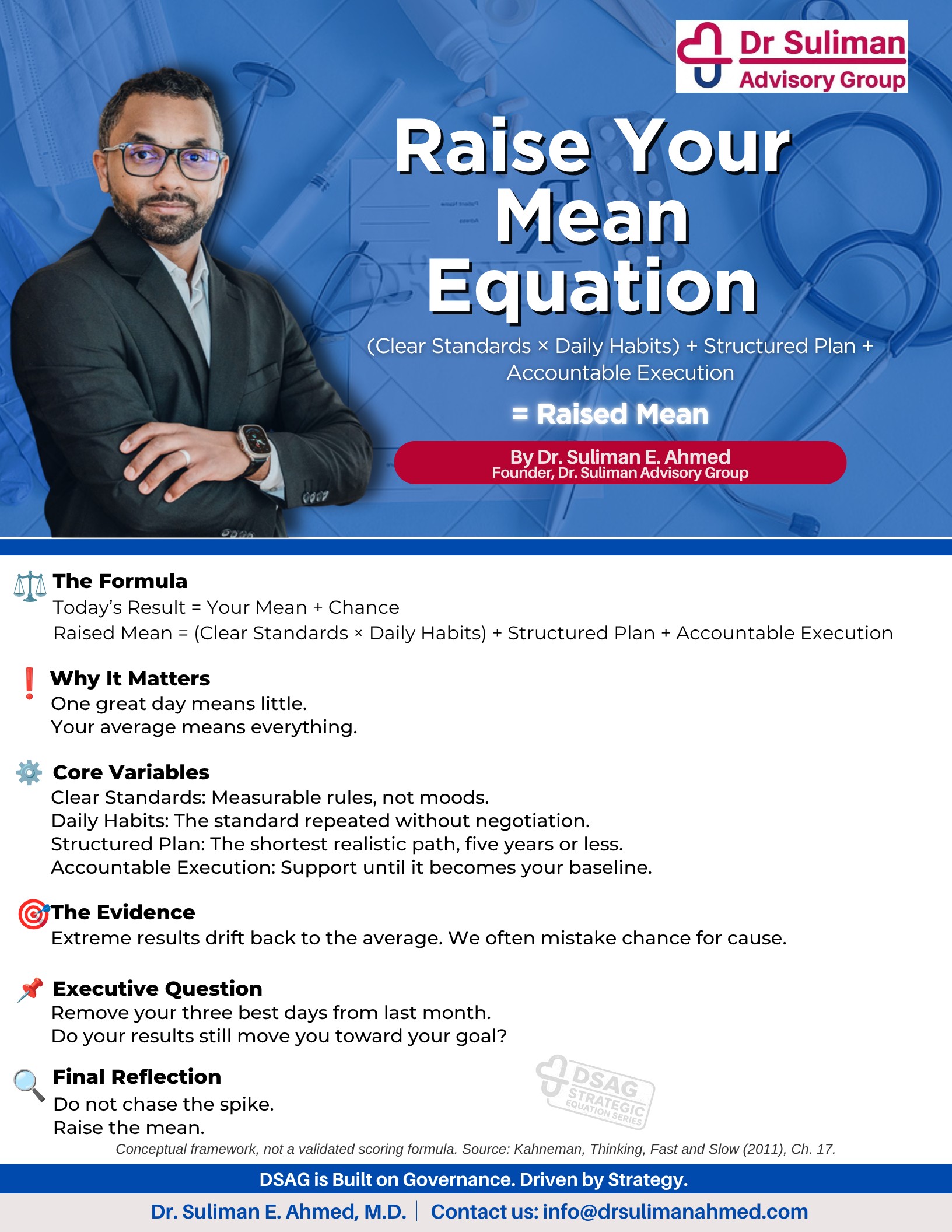
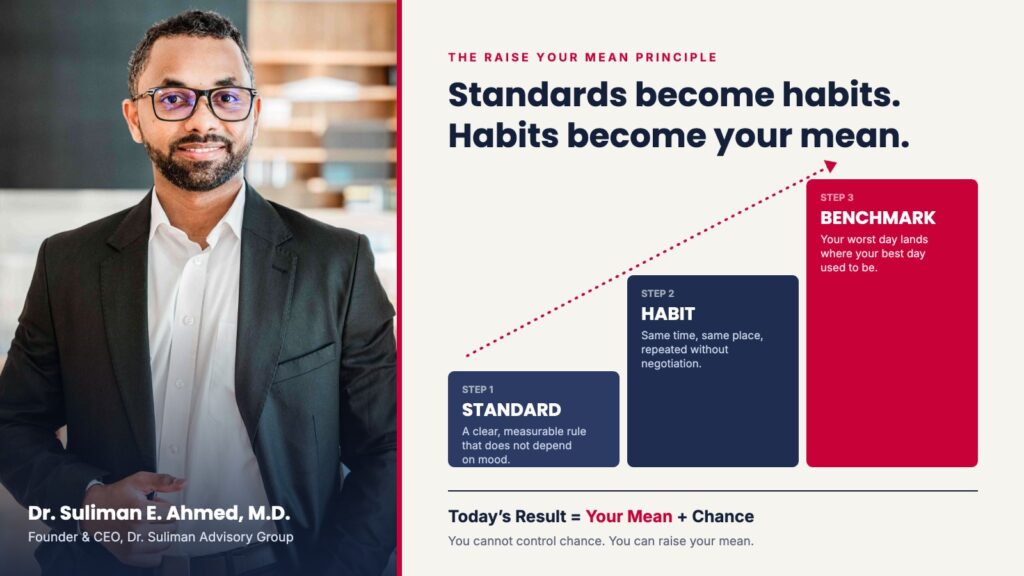
Today’s Result = Your Mean + Chance
You cannot control chance. You can control your mean.
So the real question is not, “How do I have one great day?”
It is, “How do I raise my mean, so that even on my worst day, I land above where I used to be?”
Raised Mean = (Clear Standards × Daily Habits) + Structured Plan + Accountable Execution
This is a strategic framework, not a statistical formula. The multiplication sign expresses a principle: standards without habits remain intentions, and habits without standards become routine without direction. Together, they compound.
When that multiplier is supported by a structured plan and accountable execution, temporary effort becomes a permanent new baseline.
From Standard to Habit: A Practical Example
Consider an international medical graduate preparing for U.S. licensing exams.
The standard: “I complete 40 practice questions with full review every day.” It is specific, measurable, and not dependent on mood.
The habit: The questions happen at the same time and place each morning, before work, with the review logged in a simple tracker. After a few weeks, the routine runs without negotiation.
The raised mean: On a strong day, the physician completes 60 questions. On a difficult day, after a night shift, still 40. The worst day now sits where the best day used to be.
The same logic applies to an organization: a standard (“every client inquiry receives a response within one business day”) becomes a habit (a daily inbox review assigned to a named owner), and the habit becomes the new baseline clients experience.
What Separates High Performers
High performers are not people who never have bad days. They have plenty.
The difference is that their bad days sit higher than other people’s average days.
Their standards become habits.
Their habits become their benchmark.
Their benchmark becomes their mean.
This is why chasing motivation rarely works. Motivation produces spikes, and spikes regress. Systems produce a higher mean, and a higher mean holds.
The Executive Leadership Lesson
Organizations fall into the same trap as the flight instructor.
A record quarter leads to celebration and confident forecasts. A weak quarter leads to restructuring and blame. In both cases, leaders may be reacting to chance rather than to the true performance of the system.
Strategic organizations ask a different question:
“What is our average, and what would it take to raise it permanently?”
This changes the focus from rewarding outliers to strengthening the underlying system: clearer standards, better processes, consistent habits, and measured accountability.
How DSAG Applies the Equation
At Dr. Suliman Advisory Group, this is how we work with physicians, healthcare professionals, and organizations:
- Assess: We evaluate where you stand today and the real challenges you face.
- Plan: We build a tailored plan of five years or less, designed around the shortest realistic path to your goals.
- Execute: We support you through implementation, so the plan becomes your new baseline.
No templates. Every plan is built around you or your organization.
One recent example: a physician we referred to a Supervised Medical Graduate position in Maryland applied in December and received his offer in January. One placement proves little on its own; by the logic of this article, a single result can always contain luck. What matters is that the same process produced it, and that we apply that process to every client.
The Consultant’s Diagnostic
One simple question reveals whether you are relying on good days or building a higher mean:
If you removed your three best days from last month, would your results still move you toward your goal?
If the answer is no, your progress depends on chance. If the answer is yes, your mean is rising.
Final Reflection
If five years from now you are still in the same place, that is a loss.
If you reach the place you were aiming for, that is the real gain.
A single day does not define you.
Your average does.
Do not chase the spike.
Raise the mean.
Ready to raise your benchmark? Email us at info@drsulimanahmed.com.
Dr. Suliman E. Ahmed
Founder & CEO, Dr. Suliman Advisory Group (DSAG)
Executive Advisory Series | Clinical Rigor for Strategy
Reference
Kahneman, D. (2011). Thinking, Fast and Slow (Part II, Chapter 17: Regression to the Mean). Farrar, Straus and Giroux.