

Both figures were part of my childhood. Superman and Batman were the first two answers I ever encountered to the same underlying question: what does it actually mean to be powerful, and to use that power well? That question resurfaced decades later in a different form, on the other side of a boardroom table rather than a comic-book page: strip away the cape and the cowl; and instead map each one’s distinctive operating dynamic — how they gather information, allocate limited attention, and move from problem to decision — onto the leadership of a real company. What would happen to that company’s trajectory against its competitors? Would the market reward the firm run like Superman, or the one run like Batman — and how would that verdict actually show up in the real world: in the deals a firm wins the clients it keeps, and the premium a client will pay for one specific person’s judgment?
Ask most executives who wins a competitive market, and they reach for the same numbers: headcount, budget, R&D spend, balance sheet. By that logic, the outcome should never be close. The organization with more capital, more people, and more infrastructure should out-compete the one with less, every time.
It is a much weaker answer to a different question, one that clients resolve constantly through choice rather than analysis: whose judgment do I trust with a problem I cannot fully specify myself? Who understands my situation well enough that I do not have to explain it twice?
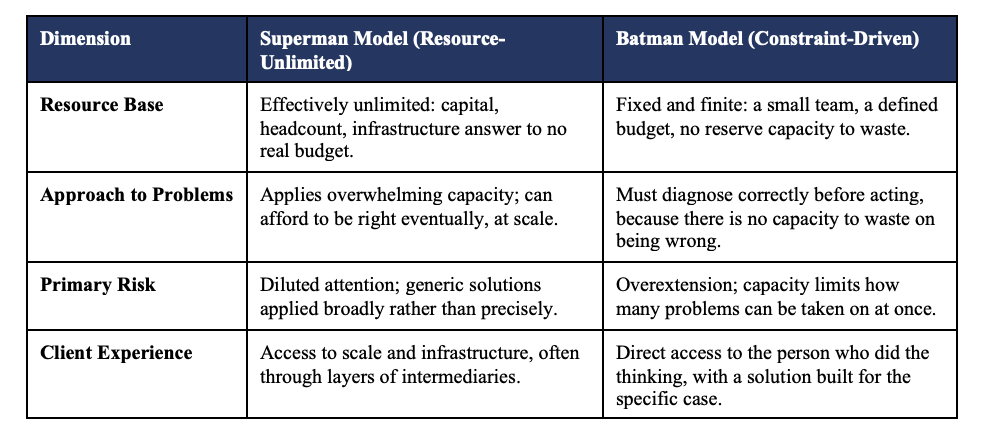
Superman has no real limits — near-invulnerable, effectively unlimited strength, resources that answer to no budget. Batman has no powers at all: a human being with a case file, a car, and a fixed amount of money and time, operating inside real constraints. Yet when Gotham needs someone to actually solve the case rather than simply overpower it, the city calls Batman.
Resource scale and client-preferred trust are not competing measures. They answer different questions.

DSAG’s own strategic radar has already picked up this pattern and given it a name: Constraint Advantage — the tendency for a resource-limited, judgment-intensive competitor to be preferred over a resource-unlimited generalist, precisely because scarcity forces a depth, focus, and personal accountability that abundance rarely produces on its own.
Not Simply Underdog Marketing
Constraint Advantage is not underdog storytelling, boutique branding, or scarcity marketing wearing a new label. Each captures one slice: underdog narrative builds emotional identification, boutique branding signals exclusivity, scarcity marketing manufactures urgency. Constraint Advantage is about how the work actually gets done — who touches the problem, how directly, how precisely tailored the response is — not about how the story is told. A firm can tell a compelling underdog story and still deliver generic, diffused, junior-staffed work. The two are independent.
Building on Existing Work
This question is not new. Porter’s focus strategy describes competing by serving a narrow segment more precisely than a broad-market rival can. Christensen’s work on disruptive innovation shows smaller entrants displacing incumbents not by outspending them but by concentrating on a need the incumbent overserves or ignores. Radjou, Prabhu, and Ahuja’s research on frugal, constraint-driven innovation documents how scarcity itself can force the prioritization and ingenuity that abundance tends to dilute. And Paharia, Keinan, Avery, and Schor’s underdog-effect research shows that clients are psychologically receptive to a disadvantaged, determined competitor — a real effect, though one that explains why clients are open to the choice, not whether the underlying judgment is actually there.
What is less common is organizing these ideas around a specific managerial question: how much of a resource-constrained competitor’s edge comes from genuinely deeper judgment, versus from narrative alone?
Two Competitive Models, Side by Side
Before proposing the dimensions, it helps to see where the two models actually diverge:
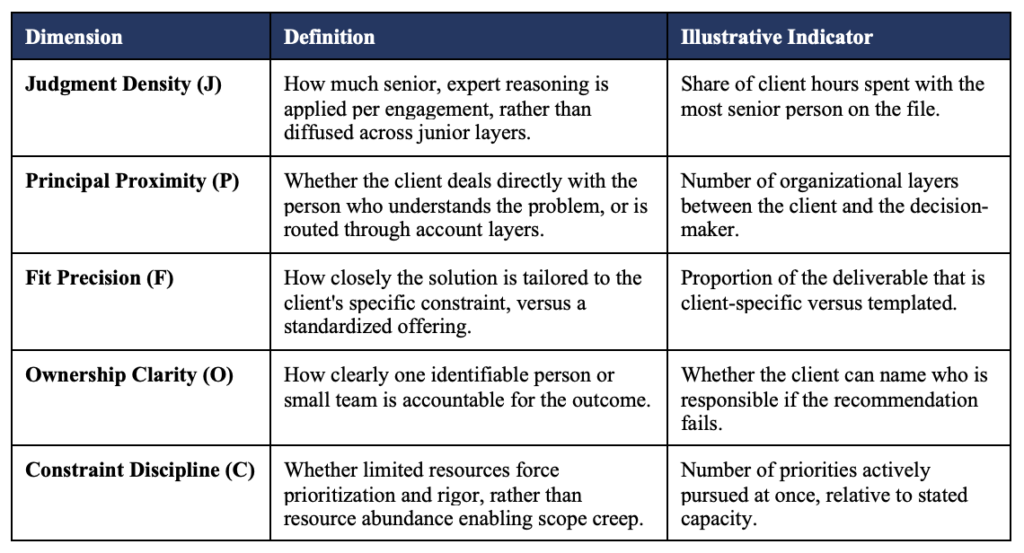
Five Proposed Dimensions
Constraint Advantage is the construct. The following five dimensions are one proposed way of operationalizing it — a starting point for discussion, not a finished or validated measurement system.
The Constraint Advantage Equation
CA = J + P + F + O + C
Judgment Density + Principal Proximity + Fit Precision + Ownership Clarity + Constraint Discipline

This is shorthand for the framework, not a validated scoring formula. It does not assume the five dimensions contribute equally — their relative weights would need to be established empirically. Its purpose is simpler: a reminder that Constraint Advantage rarely comes from a single trait. Deep judgment does not help if the client can never reach the person who has it. Direct access does not help if the answer, once reached, is generic. And discipline under constraint is only an advantage if the constraint is actually being managed — not simply endured.
A Market Illustration, Carefully Qualified
To see the Constraint Advantage equation at work in real time, consider high-stakes M&A advisory — an arena where multi-billion-dollar balance sheets compete daily against concentrated senior judgment. By enterprise scale, there is no contest. Goldman Sachs reported $58.3 billion in full-year net revenue and has held the top spot in global M&A advisory for 23 consecutive years. Morgan Stanley posted a record $70.6 billion in firmwide net revenue, with investment banking revenue up 23% to $7.6 billion. JPMorgan led the industry outright at $10.1 billion in total investment-banking fees for 2025. Each fields thousands of bankers and a global balance sheet no independent boutique can match. On paper, this is the Superman model: capacity with no real ceiling.
Yet the trend in advisory fee share tells a different story. Independent, senior-banker-intensive boutiques — Evercore, Lazard, Houlihan Lokey, PJT Partners, Moelis, and Centerview — held under 15% of U.S. M&A advisory fees in 2018. By 2025, that share had grown past 27%, with the leading boutiques generating a combined $13 billion or more in advisory revenue. Houlihan Lokey advised more transactions in 2025 than any other bank by count, despite ranking outside the top five by deal value. Boutique managing directors are reported to command a 30–50% compensation premium over bulge-bracket peers at equivalent revenue levels — a market signal that clients, and the industry itself, are paying specifically for concentrated senior judgment rather than institutional scale.
None of this means Goldman or Morgan Stanley are mispriced, or that the boutiques are undervalued — bulge brackets still dominate the largest, most balance-sheet-intensive transactions, and the two models compete on different terrain. The point is that raw resource scale and client-preferred trust in judgment are not the same claim, and a strategy built exclusively around out-resourcing the competition can miss where clients are actually making their choice.
Why This Matters for Leaders
Organizations compete for capital. They also compete for trust in judgment under conditions the client cannot fully specify — and those competitions do not always move together. A well-resourced generalist can lose a client’s confidence in a specific, high-stakes decision while a much smaller specialist earns it, on a fraction of the balance sheet.
The useful question for a resource-constrained leadership team is not “how do we out-resource the giant?” — that contest is usually not winnable and often is not the real competition. It is: how much Constraint Advantage do we generate, where is it strongest or weakest, and are we delivering it or only narrating it? That distinction can expose gaps a growth plan alone will not reveal deep Judgment Density paired with poor Ownership Clarity; strong Principal Proximity that never converts into Fit Precision; or Constraint Discipline that has quietly become under-resourcing rather than focus.
From Metaphor to Measurement
This article presents a conceptual model meant to sharpen a real strategic question, not a scored index. If these dimensions hold up to scrutiny, future work can test their relative weights, interactions, and construct validity — and determine whether Constraint Advantage can support a validated composite score. The evidence should set those weights; they should not be assumed in advance.
Final Reflection
Superman wins by having no limits. Batman wins because his limits force him to understand the problem before he moves. Clients are rarely choosing the option with the most capacity to spare — they are choosing the one who has clearly done the work. That is the Constraint Advantage Equation: Judgment Density, Principal Proximity, Fit Precision, Ownership Clarity, Constraint Discipline.
Dr. Suliman E. Ahmed
Founder & CEO, Dr. Suliman Advisory Group (DSAG)
Executive Advisory Series | Clinical Rigor for Strategy
www.drsulimanahmed.com