
THE ADVISORY PULSE
By Dr. Suliman E. Ahmed
Founder & CEO, Dr. Suliman Advisory Group (DSAG)
Editor’s Note: This article appears, in expanded form, in Dr. Suliman Elwagei Ahmed’s forthcoming book, The DSAG Executive Methodology (Founder’s Edition), coming soon on Amazon. Join the early launch list.
When Market Value Doesn’t Equal Market Presence
Toward a Competitive Presence Model
Market capitalization is the number boards and investors reach for first when asked which company is winning. It is a good answer to a narrow question: what do capital markets believe this company’s future cash flows are worth, given expectations for growth, profitability, risk, and capital structure?
It is a weaker answer to a different question that customers answer constantly through behavior, not analysis: How often do I encounter this company? How easily can I use it? How much of my routine has it captured?
These are not competing measures. They measure different phenomena.
I call the second one Competitive Presence — the extent to which an organization becomes a persistent, influential part of customers’ everyday competitive landscape, independent of what capital markets say it is worth.
Not Another Name for Brand Awareness
Competitive Presence is not simply brand awareness, customer experience, market share, or distribution reach under a new label. Each captures one slice of the picture: awareness reflects recognition, customer experience reflects interaction quality, market share reflects revenue capture, and distribution reach reflects footprint. Competitive Presence is the combined pattern across all of them — how often customers encounter an organization, how easily they can act on that encounter, and how reliably the organization delivers once they do.
Figure 1. Market Value ≠ Market Presence — the Starbucks vs. Dunkin’ paradox, DSAG Strategic Equation Series.
What is less common is organizing these ideas around a specific managerial question: how much Competitive Presence does an organization generate relative to its financial value?
Five Proposed Dimensions
Competitive Presence is the construct. The following five dimensions are one proposed way of operationalizing it — a starting point for discussion, not a finished or validated measurement system.
Brand Relevance Is the brand remembered and trusted when customers have a need?
Customer Accessibility Is it easy to find, reach, purchase from, or engage with?
Presence Density How frequently does the organization enter the customer’s physical or digital environment?
Habit Formation Does repeated use become part of everyday behavior?
Execution Consistency Does the organization reliably deliver the experience customers expect?
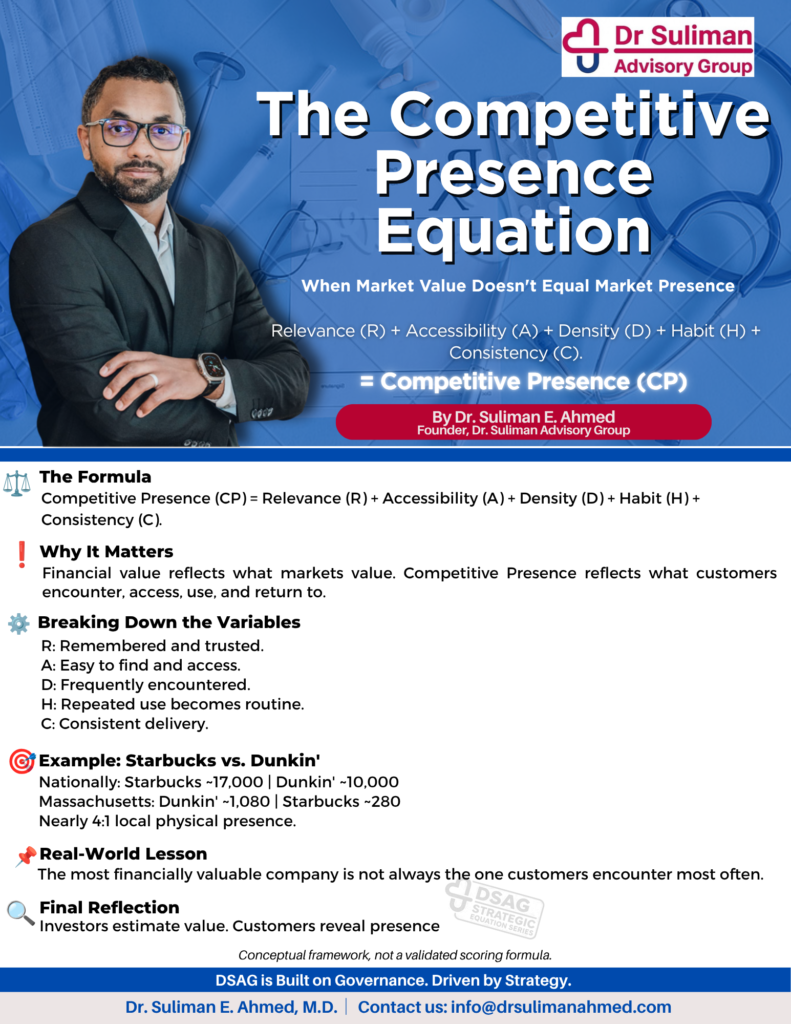
The Competitive Presence Equation
CP = R + A + D + H + C
Relevance + Accessibility + Density + Habit + Consistency
This is shorthand for the framework, not a validated scoring formula. It does not assume the five dimensions contribute equally — their relative weights would need to be established empirically. Its purpose is simpler: a reminder that Competitive Presence rarely comes from a single advantage. Being relevant does not help if access is difficult. Being accessible does not help if customers rarely encounter you. High presence density matters less if repeated encounters never become habit. And habit is hard to sustain when execution is inconsistent.
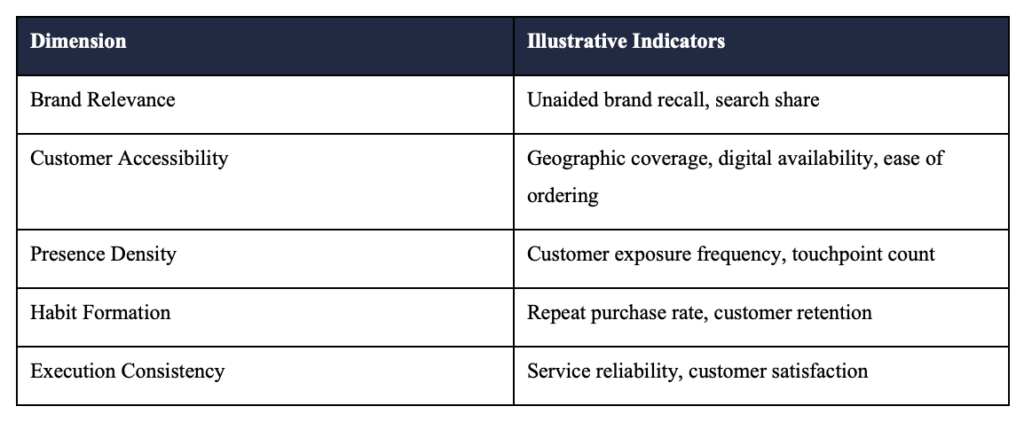
Table 1. The Competitive Presence Equation: Proposed Dimensions and Illustrative Indicators
A Regional Illustration, Carefully Qualified
Consider Starbucks and Dunkin’. At the national level, Starbucks operates substantially more U.S. locations — roughly 17,000 to Dunkin’s 10,000 — and carries a market capitalization near $120 billion as a publicly traded company. Dunkin’, by contrast, has had no standalone public valuation since Inspire Brands took it private in a 2020 acquisition. At that national scale, Starbucks’ greater enterprise value tracks with greater physical presence too.
The more interesting pattern shows up regionally. In Massachusetts — Dunkin’s home state — the ratio flips: roughly 1,080 Dunkin’ locations to Starbucks’ 280, nearly 4 to 1. Across New England and much of New York and New Jersey, Dunkin’ matches or exceeds Starbucks on store density. In those markets, many customers experience Dunkin’ as the more present brand in daily life, despite the wide gap in enterprise value between the two companies.
The point is not that Dunkin’ is undervalued or Starbucks mispriced. It is that “more valuable” and “more present in a customer’s everyday environment” are not the same claim — and a framework built exclusively around financial valuation can miss that distinction entirely.
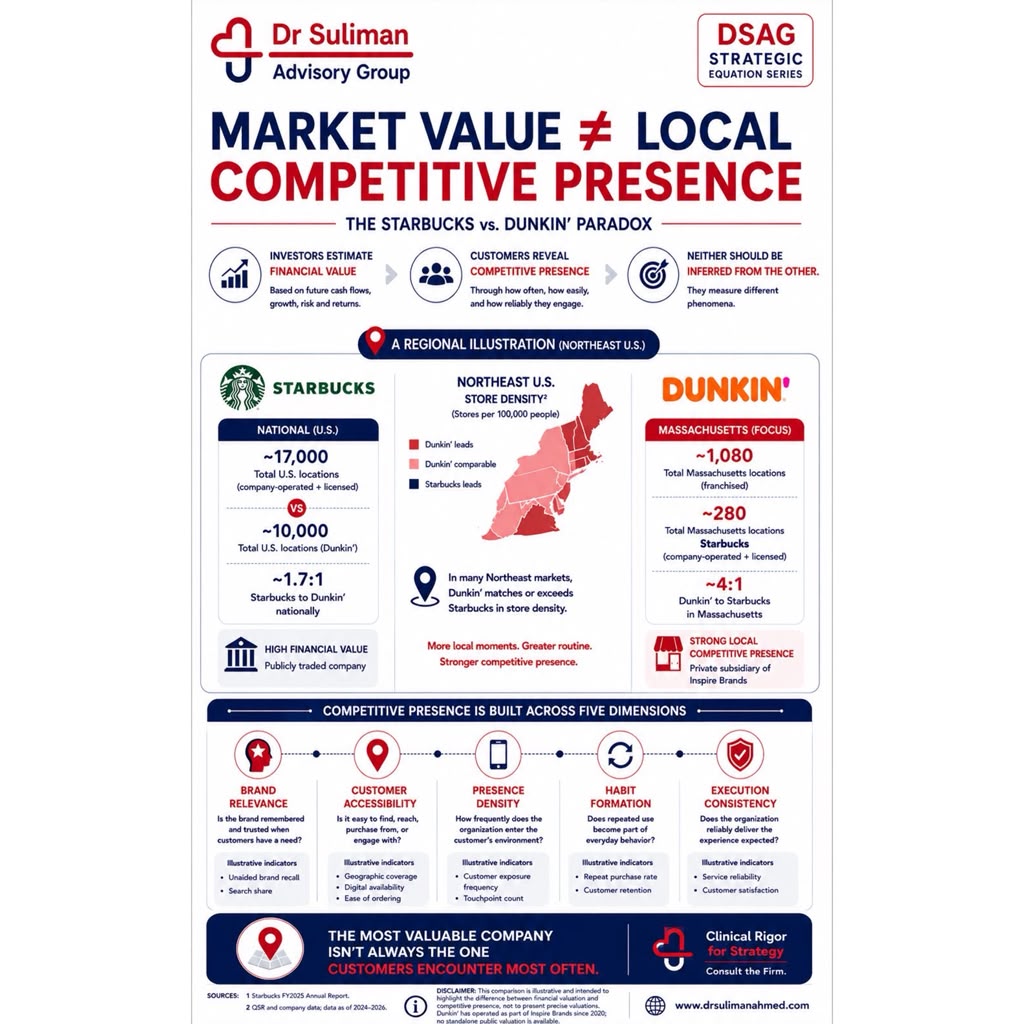
Figure 2. Market Value ≠ Local Competitive Presence — the Starbucks vs. Dunkin’ illustration, DSAG Strategic Equation Series.
Why This Matters for Leaders
Organizations compete for capital. They also compete for attention, convenience, accessibility, and habit — and those competitions do not always move together. A well-capitalized company can lose daily relevance in a specific market while a smaller competitor becomes deeply embedded in customers’ routines on a fraction of the financial value.
The useful question for a leadership team is not “how valuable are we?” It is: how much Competitive Presence do we generate, where is it strongest or weakest, and how does that compare with our financial scale? That distinction can expose strategic gaps financial metrics alone will not reveal — strong Brand Relevance paired with weak Accessibility; broad Accessibility that never converts to Presence Density; repeated encounters that never build into Habit Formation; or hard-won habit undermined by inconsistent execution.
From Conceptual Equation to Measurement
This article presents a conceptual model meant to sharpen that question, not a scored index. If these dimensions hold up to scrutiny, future work can test their relative weights, interactions, and construct validity — and determine whether Competitive Presence can support a validated composite score. The evidence should set those weights; they should not be assumed in advance.
Final Reflection
Investors estimate value. Customers reveal presence. Strong organizations understand both, and know that neither should be inferred from the other. That is the Competitive Presence Equation: Relevance, Accessibility, Density, Habit, Consistency.
Dr. Suliman E. Ahmed
Founder & CEO
Executive Advisory Series | Clinical Rigor for Strategy