Introducing the DSAG Executive Methodology:
An Evidence-Based Framework for Executive Decision-Making
Version 1.0 — July 2026
By Dr. Suliman Advisory Group LLC (DSAG)
Reviewed and edited by Dr. Suliman E. Ahmed, Founder and CEO, Dr. Suliman Advisory Group LLC
Editor’s Note: This article introduces selected concepts from Dr. Suliman Elwagei Ahmed’s forthcoming book on evidence-based strategic leadership and organizational growth.
The methodology presented in this article is intended as a conceptual framework that will continue to evolve through practical application, empirical evaluation, and independent scholarly review.
The Central Paradox of Scale
Most organizations do not fail because they lack opportunities. They fail because they misdiagnose the constraint that determines whether those opportunities can create value.
When growth stagnates, executive teams typically default to an execution-centric playbook: amplifying sales activity, expanding marketing budgets, increasing headcount, or pursuing new partnerships. Yet a common pattern emerges. Despite a substantial surge in organizational effort, long-term growth frequently remains inconsistent, erratic, and difficult to sustain.
Growth is limited not by the absence of opportunity, but by the presence of an unidentified strategic constraint.
The DSAG Executive Methodology proposes that strategic decisions are best approached with the same diagnostic discipline found in clinical medicine. A physician does not prescribe a complex treatment plan before isolating the underlying pathology. Likewise, an enterprise should rarely deploy capital into growth initiatives before identifying the specific source of systemic friction.
To move from assumption-driven execution to evidence-based scale, leadership teams must navigate a unified, five-stage decision framework.
- Diagnosis Before Recommendation
Traditional advisory engagements are frequently structured around immediate, pre-packaged solutions. The methodology inverts this dynamic, beginning instead with systematic interrogation.
When analyzing a complex enterprise, the primary objective is isolating the systemic headwinds that prevent promising initiatives from reaching full velocity. This demands a clinical separation between visible symptoms and their underlying root causes.
Consider an organization facing an apparent customer acquisition crisis. While the immediate symptom mirrors a pipeline failure, a deeper diagnostic investigation frequently suggests an entirely different operational reality:
- Market Positioning: Subtle misalignment between product utility and high-value customer segments.
- Operational Bottlenecks: Downstream capacity constraints that restrict fulfillment.
- Stakeholder Disengagement: Interdepartmental friction or misaligned incentive models that stall execution.
- Implementation Complexity: Onboarding friction that quietly reduces early-stage customer retention.
When an executive team treats a symptom without a formal diagnosis, they choose to bet corporate resources on a series of untested assumptions.
- Pattern Recognition Across Systems
Enterprises rarely falter due to an isolated, standalone variable. Commercial scalability typically emerges from the dynamic interplay between multiple foundational systems:
- Clinical and operational performance
- Commercial and go-to-market execution
- Market incentives and stakeholder behaviors
- Customer adoption and strategic partnerships
The methodology is designed around a central proposition: when independent organizational indicators repeatedly converge toward the same explanation, confidence increases that leadership is observing an underlying strategic constraint rather than isolated operational symptoms. Rather than evaluating operational variables in isolation, the methodology examines where recurring evidence across multiple systems points toward a common source of organizational friction.
The following comparison illustrates the analytical emphasis of the DSAG Executive Methodology relative to common approaches used across strategy and advisory work.
These characteristics are intended to highlight the distinctive design priorities of the methodology rather than to represent all organizations, consulting firms, or strategic frameworks.
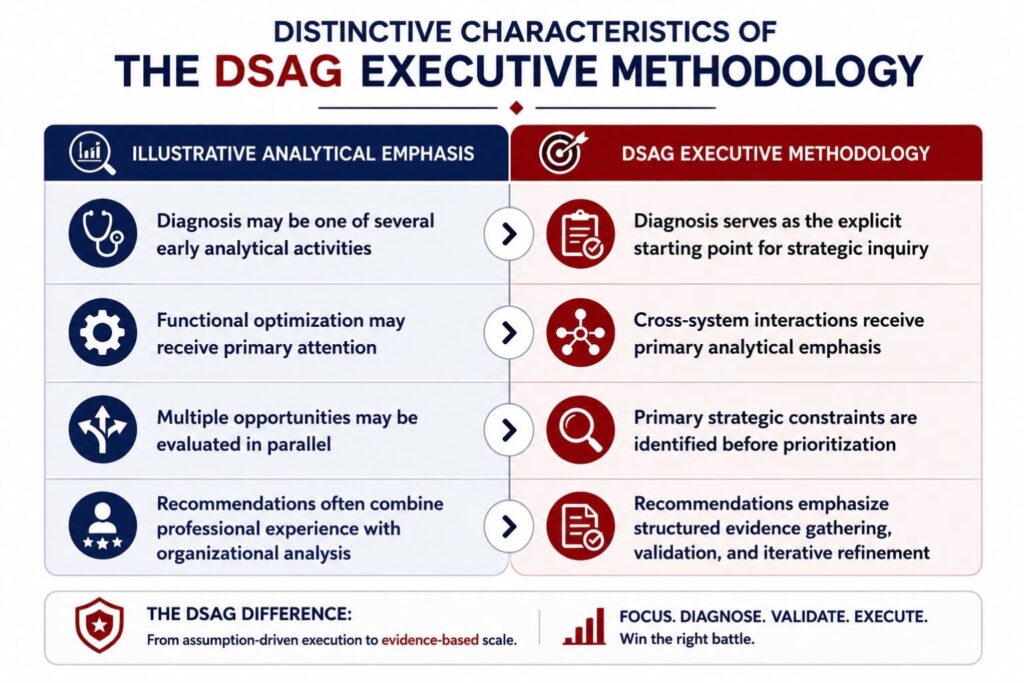
Figure 1. A visual comparison illustrating the distinctive analytical characteristics of the DSAG Executive Methodology, emphasizing its evidence-based, diagnostic approach to executive decision-making.
Once recurring patterns are laid bare, the framework shifts to a formal Strategic Constraint Analysis (SCA). While modern enterprises routinely juggle dozens of operational challenges, rarely are those challenges of equal strategic consequence. SCA separates secondary symptoms from the primary constraint, allowing executive leadership to focus capital and cognitive energy on the points of maximum organizational leverage.
Observations from the Field: A Healthcare Advisory Case
During one advisory engagement with a growing healthcare organization, leadership initially believed that revenue stagnation was driven by a customer acquisition deficit. They prepared a substantial expansion of their sales pipeline.
The analysis suggested, however, a different reality: while market demand appeared exceptionally strong, implementation delays and onboarding complexity were consistently associated with reduced adoption rates during the critical first 90 days.
Based on these findings, leadership chose to halt the planned marketing spend and redirect resources toward stabilizing their implementation workflow. Early pilot observations suggested improved customer adoption and a more predictable implementation pathway without increasing customer acquisition costs.
Note: Details of this example have been anonymized and selectively modified to preserve client confidentiality while accurately illustrating the analytical process.
Individually, each component addresses a distinct aspect of executive decision-making. Collectively, they form an integrated diagnostic architecture in which recurring patterns reveal potential constraints, Strategic Constraint Analysis establishes executive priorities, strategic modeling evaluates alternative courses of action, and Evidence-Based Validation tests those alternatives before broader organizational implementation.
- Intellectual Architecture: Where DSAG Stands
The DSAG framework does not exist in an academic vacuum; it acknowledges and builds upon the foundational pillars of modern strategic thought:
- Michael Porter’s views on competitive positioning and structural barriers.
- Eliyahu Goldratt’s work on the Theory of Constraints in operational environments.
- Peter Senge’s disciplines regarding systems thinking within complex organizations.
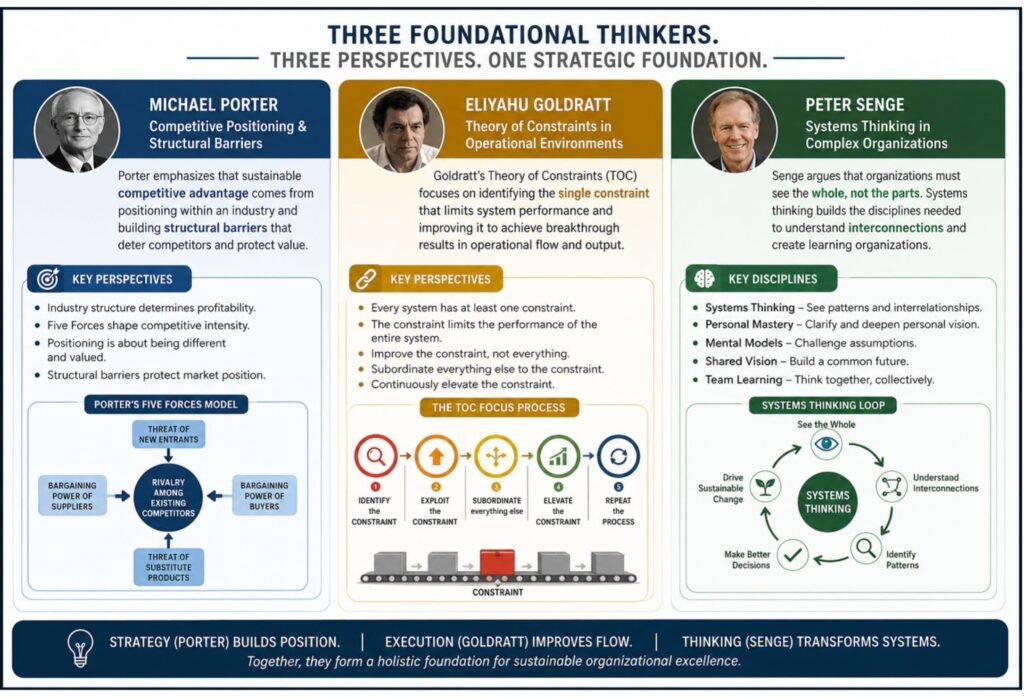
Figure 2. A visual overview of three foundational strategic management perspectives, illustrating competitive positioning, the Theory of Constraints, and systems thinking.
DSAG draws from these traditions while extending them into contemporary healthcare, advisory, and knowledge-intensive organizations where organizational behavior often influences scalability as much as operational efficiency. While traditional constraint methodologies focus heavily on linear operational bottlenecks or asset optimization.
DSAG integrates stakeholder behavior, market adoption incentives, product implementation friction, and executive decision-modeling into a unified framework designed explicitly for highly complex, knowledge-driven environments.
Rather than replacing established strategic frameworks, the DSAG Executive Methodology is intended to complement them by providing a structured approach for diagnosing which organizational constraint should receive executive attention before strategic interventions are selected.
- Strategic Modeling and Real-World Validation
An observation only gains strategic utility when it is translated into a structured decision model. The fundamental goal of modeling is not to project an idealized future, but to deliver absolute clarity on current variables.
High-impact strategic models help a leadership team categorize corporate opportunities into three distinct tiers:
- Accelerators: Initiatives that actively remove constraints and multiply enterprise value.
- Sustaining Activities: Table-stakes operations required to maintain the business but are incapable of yielding exponential scale.
- Value Detractors: High-friction activities that consume disproportionate bandwidth while returning minimal long-term enterprise leverage.
Because theoretical analysis alone cannot fully mitigate strategic risk, the framework incorporates empirical validation as one of its central design principles. Before scaling an initiative, the methodology recommends pressure-testing it under real-world conditions.
The methodology recommends targeted micro-pilot testing to answer specific strategic questions: Which niche user segments exhibit the lowest adoption friction? Which specific onboarding paths generate the shortest time-to-value? By gathering data in the field before deploying macro-budgets, organizations can systematically replace high-stakes assumptions with concrete operational evidence.
- Executive Focus and Selective Growth
The ultimate bottleneck to corporate growth is almost never a lack of ideas; it is an overabundance of executive priorities. When a leadership team attempts to pursue too many viable paths simultaneously, they dilute their execution capacity to the point of systemic failure.
To counter this, the framework evaluates every potential opportunity through a structured prioritization matrix:
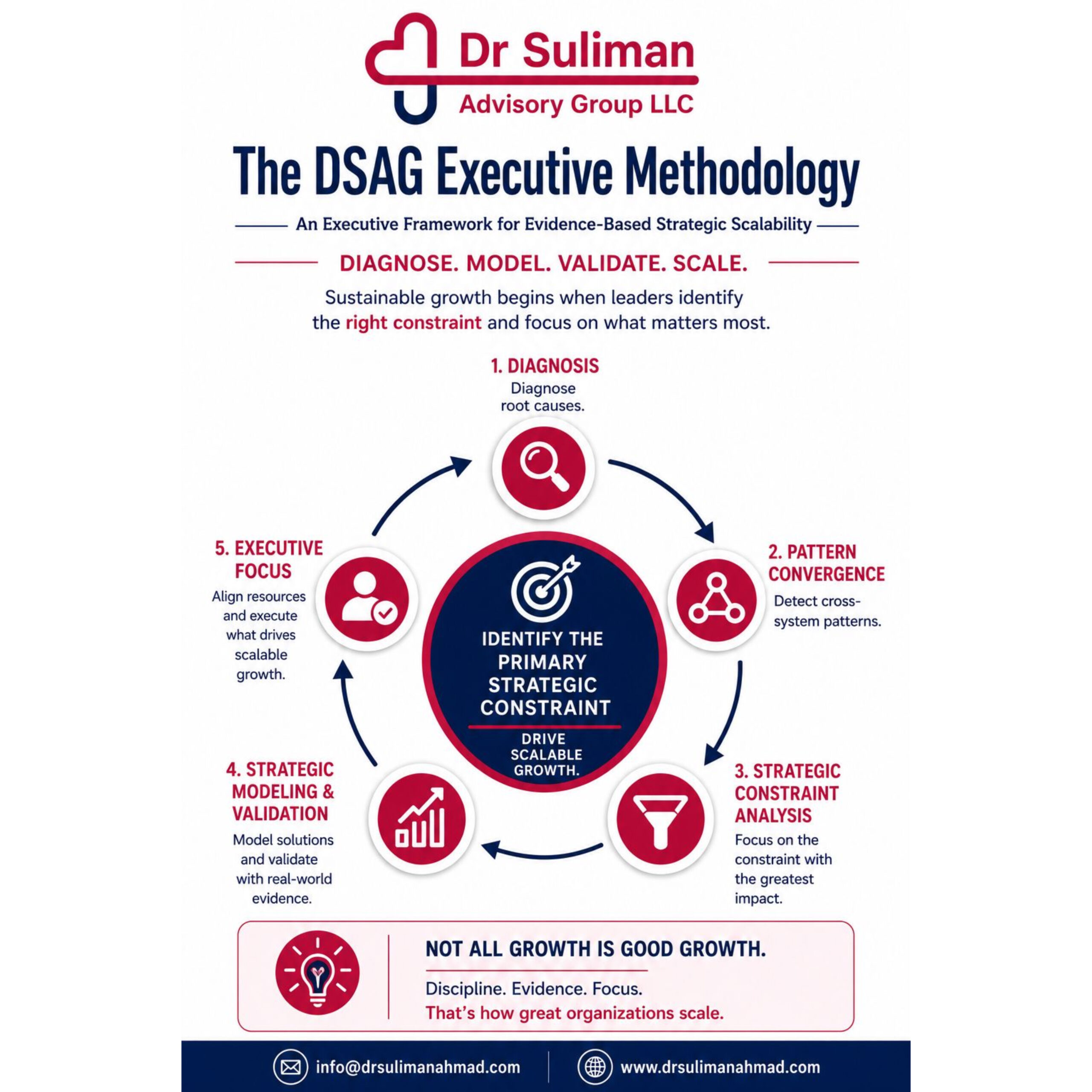
Figure 3 summarizes the integrated stages of the DSAG Executive Methodology.
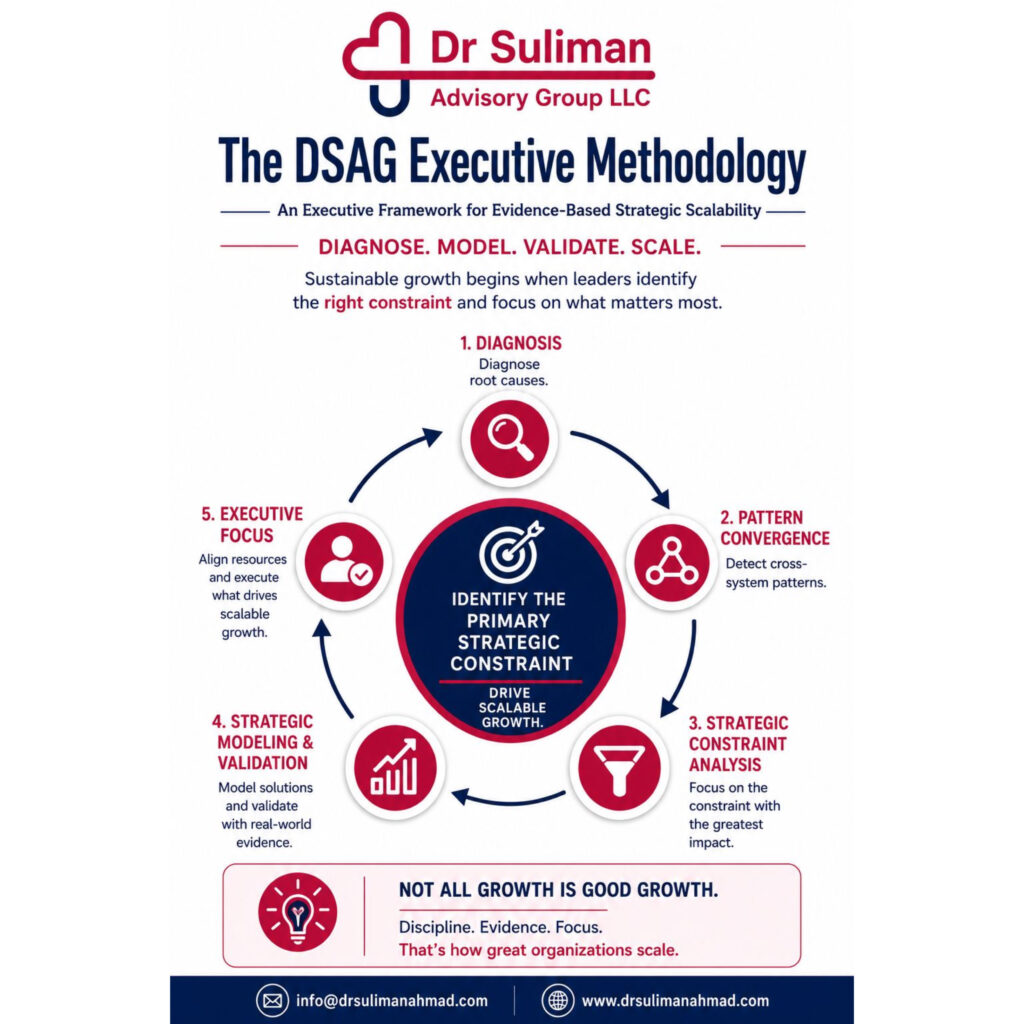
Figure 3. A visual overview of the DSAG Executive Methodology, illustrating its five-stage framework for evidence-based strategic scalability.
Typical DSAG Deliverables
- Strategic Constraint Map: Visualizing systemic points of friction
- Pattern Convergence Report: Hard data mapping cross-system dependencies
- Executive Prioritization Matrix: Clarity on resource deployment
- Dynamic Decision Model: Scenario testing for capital allocation
- Validation Roadmap: Empirical testing structures for micro-pilots
- Scalability Recommendations: A phased execution playbook
This architecture underpins our foundational philosophy: Not all growth is good growth.
Unselective growth merely generates exhausting corporate activity without yielding operational leverage. It inflates overhead, fractures organizational culture, and risks degrading service quality. Conversely, sustainable, high-value growth requires disciplined selectivity. The enterprises that scale successfully are not those that attempt to capture every passing market opportunity. They are the disciplined organizations that identify their primary constraint, protect their executive focus, and allocate capital with precision.
- Scope and Limitations of the Framework
Like any strategic framework, DSAG is intended to support executive judgment rather than replace it. As with any evolving executive methodology, future refinement should be expected as additional applications, empirical observations, and independent evaluations become available. The methodology should therefore be viewed as a decision-support framework rather than a predictive model. Its conclusions depend heavily on the quality of available evidence, organizational transparency, and a leadership willingness to validate assumptions through disciplined experimentation.
The methodology is intended primarily for organizations whose performance depends on the interaction of multiple strategic, operational, and behavioral systems. Organizations operating in highly standardized environments with relatively simple value chains may derive comparatively less benefit from this approach, although individual analytical components may still provide useful insights when applied selectively.
The Paradigm Shift
Complex enterprise decisions cannot be solved via corporate intuition, brute-force effort, or generic capability checklists. True strategic leadership requires an unyielding commitment to a consistent process:
Diagnose → Model → Validate → Scale
Organizations rarely lack great ideas. They lack a disciplined, repeatable process for determining which of those ideas actually deserve execution. Sustainable growth and lasting enterprise value begin the moment a leadership team shifts its strategy from assumption to evidence.
—Ultimately, the value of the DSAG Executive Methodology should be judged not by the elegance of its conceptual framework, but by its ability to improve executive decision quality, resource allocation, and organizational learning across diverse real-world settings.
Looking Ahead
The DSAG Executive Methodology is not intended to be viewed as a finished or immutable system. Like the organizations it is designed to support, it is expected to evolve through disciplined application, structured evaluation, empirical observation, and independent professional critique. Continuous refinement is therefore not merely a consequence of applying the methodology, but one of its defining design principles.
Selected Foundations
- Fixsen, Dean L., Naoom, Sandra F., Blase, Karen A., Friedman, Robert M., & Wallace, Frances. Implementation Research: A Synthesis of the Literature. University of South Florida, Louis de la Parte Florida Mental Health Institute, National Implementation Research Network.
- Goldratt, Eliyahu M. The Goal: A Process of Ongoing Improvement. North Gate College Press. (Theory of Constraints).
- Porter, Michael E. Competitive Strategy: Techniques for Analyzing Industries and Competitors. The Free Press.
- Senge, Peter M. The Fifth Discipline: The Art & Practice of the Learning Organization. Doubleday/Currency.