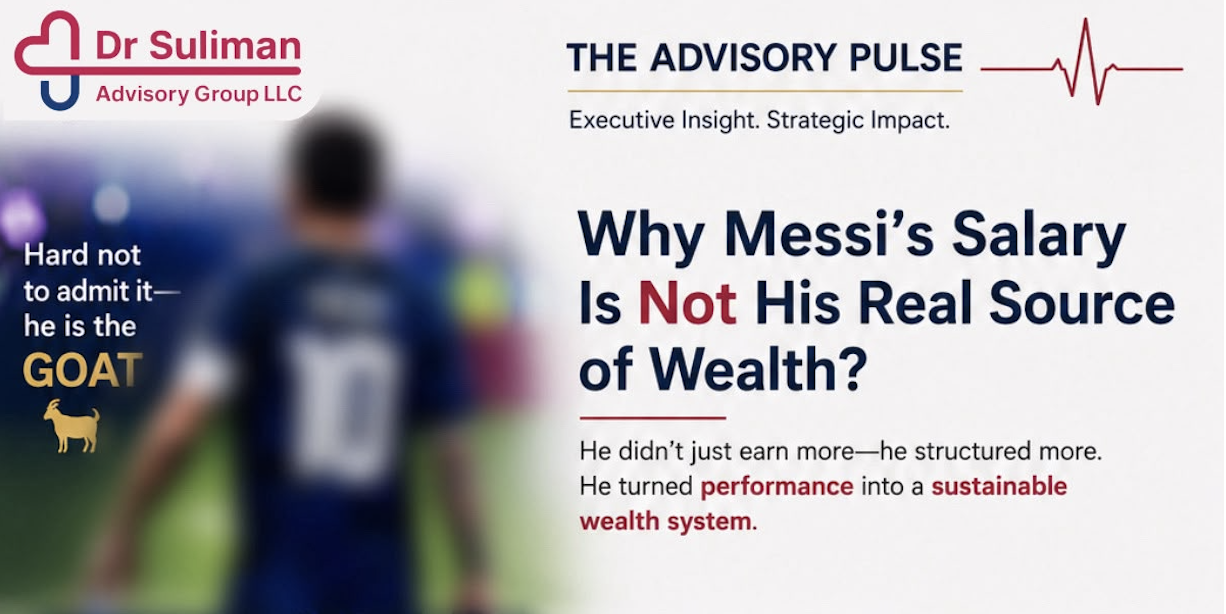
Why Messi’s Salary Is No Longer the True Source of His Wealth
By Dr. Suliman E. Ahmed
Founder & CEO, Dr. Suliman Advisory Group (DSAG)
Editor’s Note: This article introduces selected concepts from Dr. Suliman Elwagei Ahmed’s forthcoming book on evidence-based strategic leadership and organizational growth.

Introduction
When news broke that Lionel Messi’s net worth had surpassed $1.1 billion, the common explanation was straightforward: “He is one of the greatest football players in history. Naturally, he is wealthy.”
From an executive advisory perspective, however, that explanation is incomplete.
History has produced countless world-class athletes, entertainers, and professionals whose extraordinary talent generated remarkable incomes, yet failed to create lasting wealth. Exceptional performance alone rarely builds sustainable enterprise value.
The more meaningful executive question is not:
“How much does Messi earn?”
It is:
“Why is his salary no longer the primary source of his wealth?”
The answer extends far beyond sports. It illustrates one of the most important strategic lessons for executives, entrepreneurs, and organizational leaders: sustainable wealth is created by designing value systems, not merely maximizing active income.
The Sustainable Wealth Equation
Sustainable wealth is not achieved simply by earning more. It emerges when exceptional performance builds reputation, and that reputation is intentionally converted into scalable assets that continue creating value over time.
Sustainable Wealth = (Exceptional Performance × Global Reputation) + Strategic Ownership + Value-Sharing Partnerships + Recurring Revenue
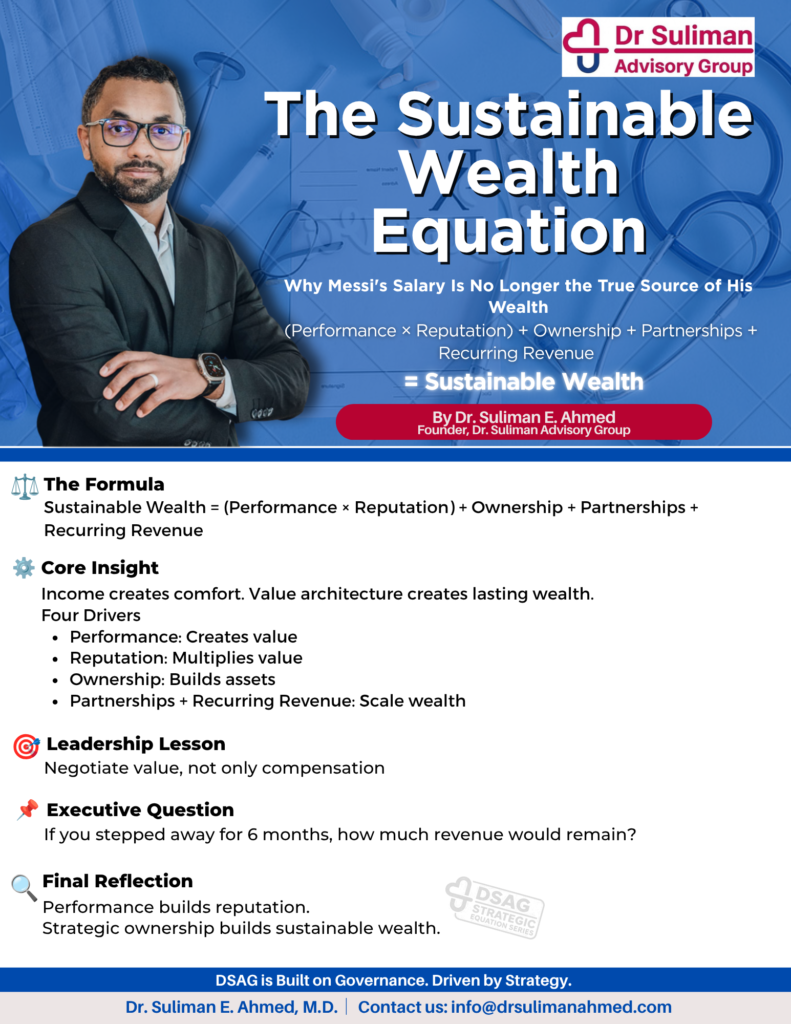
The multiplication symbol is intentional.
Performance without reputation creates limited leverage. Reputation without sustained performance gradually loses value. Together, however, they create a powerful multiplier that expands influence, market opportunity, and long-term economic potential.
When that multiplier is combined with ownership, equity participation, strategic partnerships, and recurring revenue streams, temporary success evolves into an enduring economic system.
From High-Paid Professional to Strategic Enterprise Partner
If Messi’s earnings depended solely on his playing contract, his financial future would remain closely tied to his physical performance and the limited duration of his athletic career.
Instead, the structure of his agreement with Inter Miami illustrates a broader strategic transition from compensation toward long-term value creation.
Beyond his salary, publicly reported elements of the agreement include:
- Equity-related opportunities connected to the club and league.
- Revenue-sharing arrangements linked to global streaming platforms and commercial partnerships.
- Long-term monetization of intellectual property and personal brand assets.
These components represent a shift from generating income through personal performance to building assets capable of creating value beyond active participation.
This distinction separates active income from enterprise wealth.
- Active income rewards current effort.
- Strategic assets continue generating value long after the original work has been completed.
The Executive Leadership Lesson
Many organizations devote significant attention to negotiating compensation.
Strategic organizations focus on designing value architecture.
Salary is a temporary operating expense. Ownership, licensing rights, equity participation, intellectual property, and strategic partnerships fundamentally change how value compounds over time.
For executives, the question is no longer:
“How can we increase next quarter’s revenue?”
The more strategic question becomes:
“How can we redesign our business model so enterprise value continues to grow independently of any single individual?”
Organizations that answer this question effectively become more resilient, scalable, and valuable over the long term.
The Consultant’s Diagnostic
One simple question often reveals whether an organization has created a scalable enterprise or merely a highly compensated job:
If the founder or primary revenue generator stopped working for six months, what percentage of the organization’s revenue would continue uninterrupted?
The answer reflects the strength of the organization’s underlying value architecture.
Businesses built around systems, ownership, recurring revenue, and transferable assets continue creating value even when individual contributors step away.
Those built solely around personal effort rarely do.
The Executive Decision
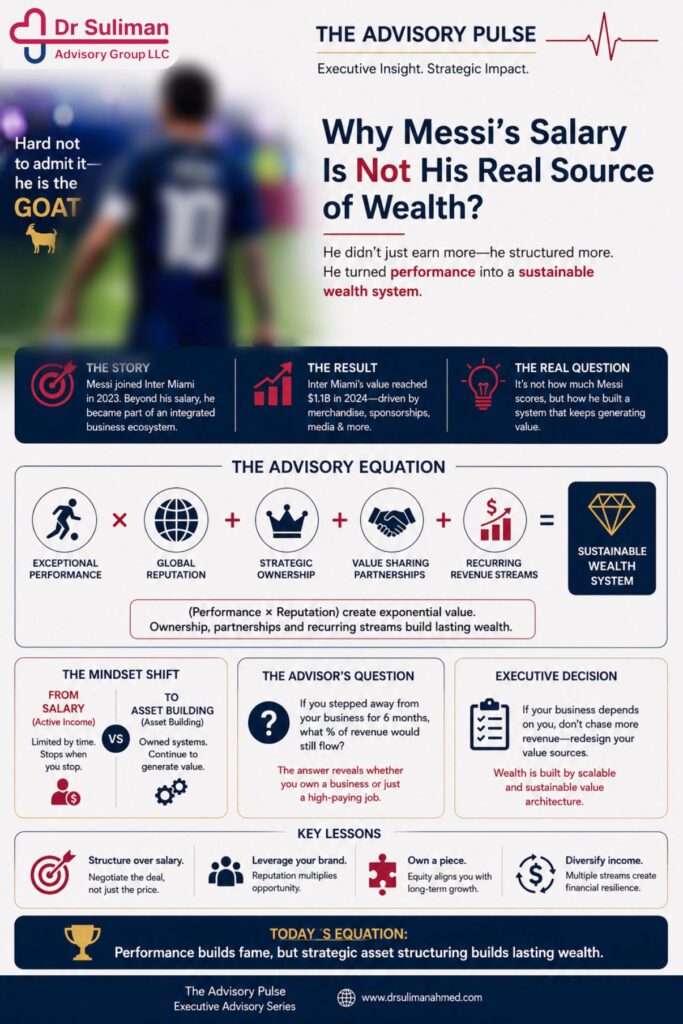
Every organization operates within a value architecture, whether intentionally designed or not.
If your current business model depends primarily on your personal time, expertise, or daily presence, your strategic challenge is not simply increasing activity or sales volume. It is redesigning the underlying architecture that produces value.
Lasting prosperity belongs to organizations that transition from selling expertise to building systems, from earning income to creating assets, and from depending on individual performance to engineering scalable enterprise value.
Messi’s story is not simply about athletic greatness. It is a contemporary illustration of a timeless executive principle:
The greatest wealth is created not by working harder, but by designing systems that continue creating value long after the work itself has been done.
Dr. Suliman E. Ahmed
Founder & CEO, Dr. Suliman Advisory Group (DSAG)
Executive Advisory Series | Clinical Rigor for Strategy