
The Strategic Partnership Equation
By Dr. Suliman E. Ahmed – Healthcare Strategist
Editor’s Note: This article contains selected concepts from Dr. Suliman Elwagei Ahmed’s forthcoming book on evidence-based strategic leadership and organizational growth.
Organizations do not fail because they lack resources.
They stall because they rely on them.
Sustainable growth, resilient leadership, and scalable healthcare systems are not built internally alone. They are built through structured partnerships that extend capability beyond organizational limits.
More precisely:
Strategic partnership is not collaboration. It is leverage.
The Misconception
Many leaders approach partnerships as shared effort.
Shared goals.
Shared execution.
Shared visibility.
This framing is incomplete.
Partnership is not about doing more together.
It is about achieving more without proportionally increasing cost, complexity, or infrastructure.
The Equation
To operationalize this shift:
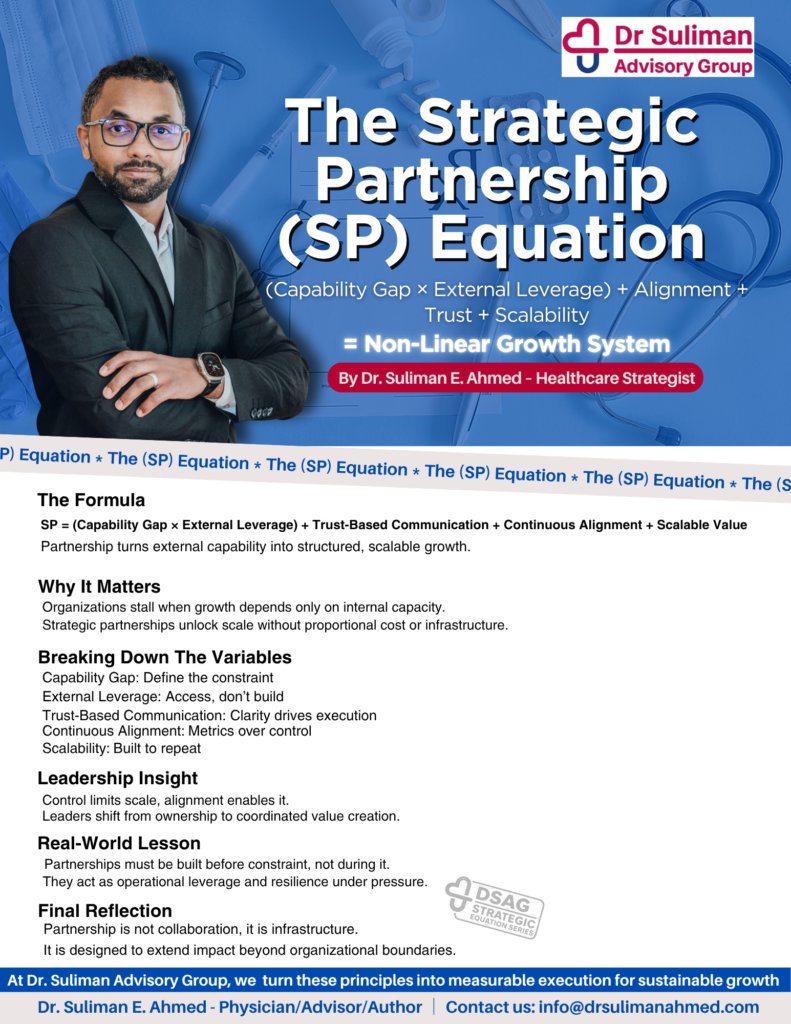
Strategic Partnership (SP) = (Capability Gap × External Leverage) + Alignment + Trust + Scalable Value
This equation defines how organizations move from linear expansion to network-driven scale.
It is not theoretical.
It is structural.
Capability Gap × External Leverage
Growth is constrained not by ambition, but by limits in:
capacity, access, expertise, and execution.
Most organizations respond internally:
Hire more.
Build more.
Spend more.
This creates linear growth.
Strategic partnerships introduce leverage.
Instead of building capacity, organizations access it.
Instead of expanding infrastructure, they extend it.
This is how systems scale without proportional cost.
From Infrastructure to Network
Healthcare systems are not limited by knowledge.
They are limited by access and coordination.
Strategic partnerships enable:
- Expansion without building facilities
- Distributed care delivery
- Faster deployment of services
The hub-and-spoke model is not collaboration.
It is system design.
Alignment: The Substitute for Control
Partnership fails where alignment is absent.
Leaders often attempt to maintain control across distributed systems.
This does not scale.
Alignment does.
It is built through:
- Shared KPIs
- Data visibility
- Transparent performance metrics
Control preserves structure.
Alignment enables scale.
Trust-Based Communication
Execution speed is determined by communication quality.
Without trust:
decisions slow, friction increases, coordination weakens.
With trust:
information flows faster, issues surface earlier, systems adapt.
Trust is not cultural alone.
It is operational efficiency.
Scalable Value: The Differentiator
Not all partnerships are strategic.
A true strategic partnership must:
- Extend beyond a single initiative
- Integrate into the operating model
- Deliver repeatable value
Otherwise, it remains transactional.
Growth: From Linear to Networked
Traditional growth follows internal capacity:
Hire more. Build more. Spend more.
Strategic growth is network driven.
Partnership enables:
- Market access without infrastructure delay
- Faster execution through shared intelligence
- Expansion without full operational burden
This is not incremental growth.
It is non-linear expansion.
Leadership: The Real Barrier
The primary barrier to partnership is not structural.
It is psychological.
Leaders equate control with quality.
In complex systems:
control does not scale, alignment does.
This is where most partnerships fail, not in design, but in mindset.
Connection Is Currency
In today’s environment, capital is not only financial.
Access is capital.
Credibility is capital.
Relationships are capital.
A strong partnership compresses time.
What would take months of validation can be achieved through a single aligned relationship.
This is not convenience.
It is strategic acceleration.
The Hidden Advantage: Resilience
Partnership is not only a growth tool.
It is a resilience mechanism.
- Financial pressure
- Operational disruption
- Limited access
Organizations with partnerships do not restart.
They redistribute.
Partnership becomes operational liquidity.
From Collaboration to Leverage
To operationalize this model:
- Identify the constraint
- Map external capability
- Design for outcomes, not activity
- Build alignment before execution
This is how partnerships move from concept to system.
When You Run Out of Options
Most organizations attempt partnerships during constraint.
That is reactive.
Strategic partnerships must be built before they are needed.
Because under pressure, the question is not:
Who can we reach?
It becomes:
Who is already aligned with us?
Final Thought
At the intersection of Healthcare, Growth, and Leadership:
Partnership is not optional.
It is infrastructure.
Organizations that rely solely on internal capacity will reach limits.
Organizations that design partnerships intentionally expand beyond them.
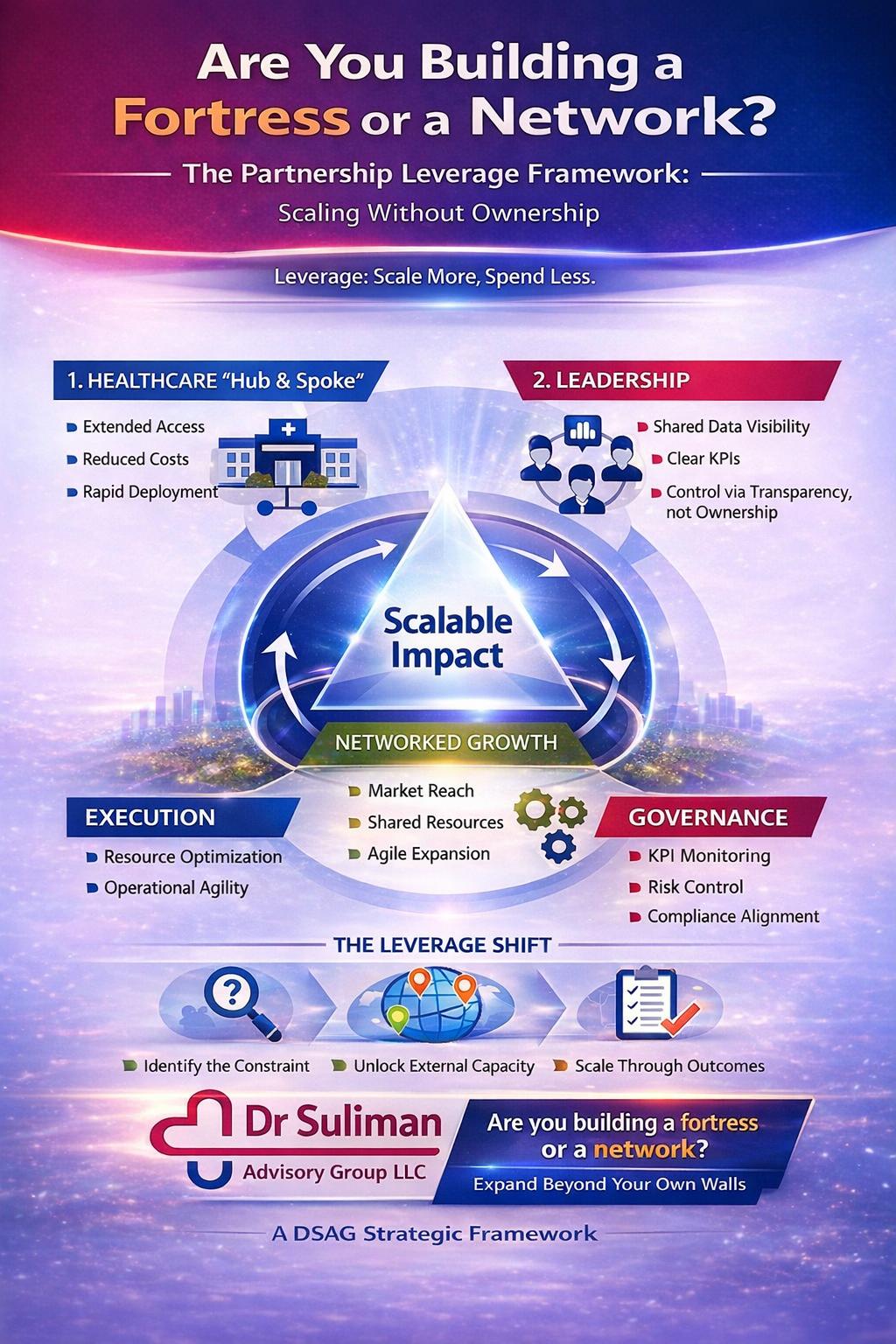
The real question is no longer:
Are you building capacity?
It is:
Are you building a system that scales beyond your own walls,
or one that will eventually be constrained by them?