The Most Dangerous Leadership Mistake Is Crossing Decision Boundaries
By Dr. Suliman E. Ahmed – Healthcare Strategist
Editor’s Note: This article contains selected concepts from Dr. Suliman Elwagei Ahmed’s forthcoming book on evidence-based strategic leadership and organizational growth.
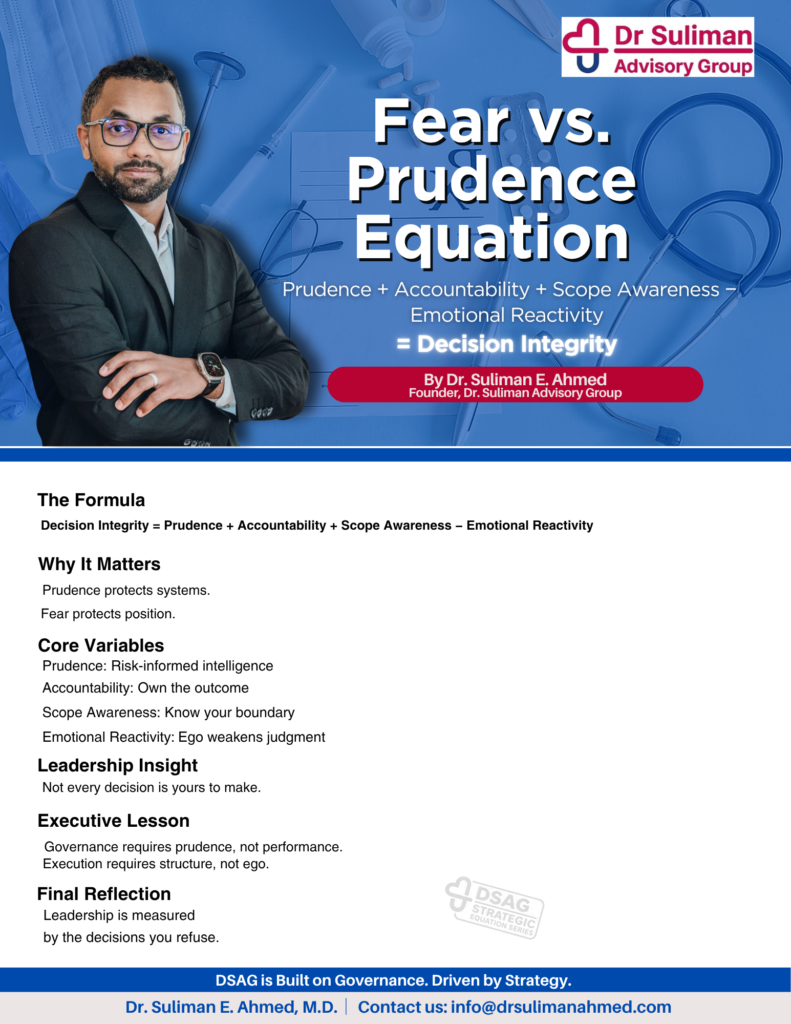
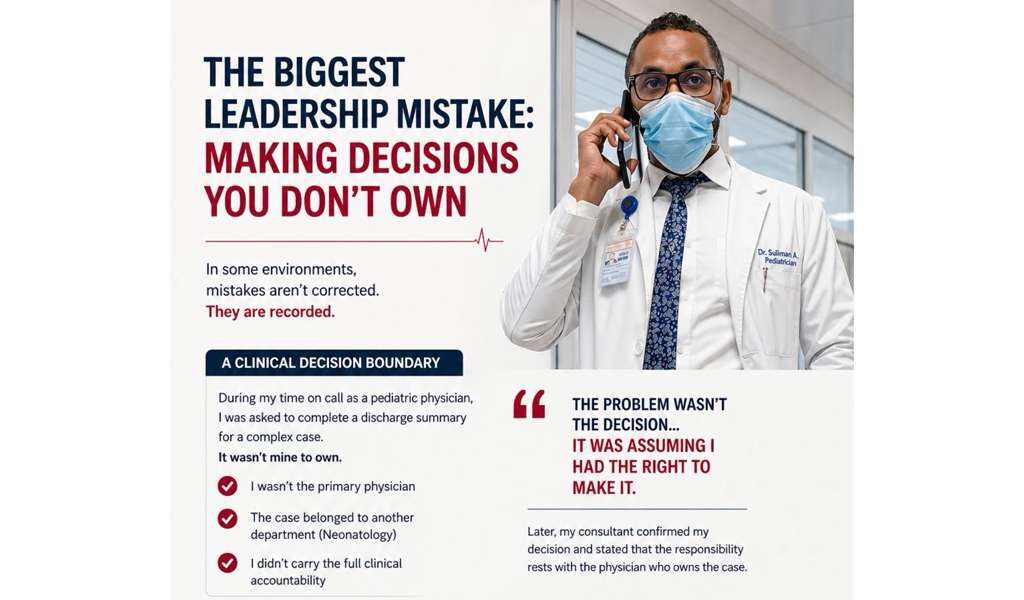
In some environments, mistakes are not corrected, they are recorded.
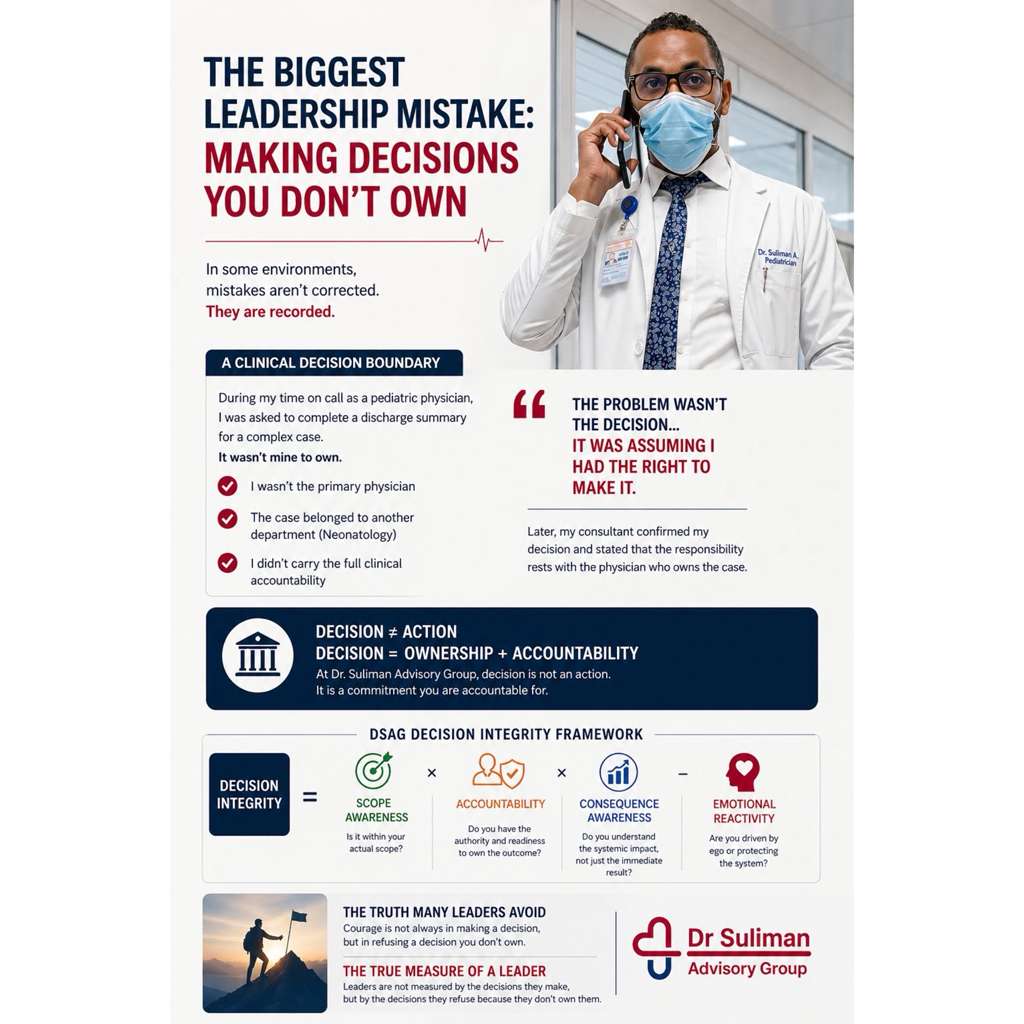
During my years practicing as a pediatric physician in Saudi Arabia, I encountered a moment that was far more than a professional incident. It became a defining lesson in leadership, accountability, and the boundaries of decision-making.
During one hospital shift, the team was asked to prepare a discharge summary for a complex case. A discharge summary is not a routine administrative task, it is a permanent medical and legal document upon which future clinical decisions may depend, and for which a physician may be held accountable years later.
At that moment, a colleague attempted to shift that responsibility to me.
But I understood three critical facts:
- I was not the supervising physician for the case
- The case belonged to the neonatal department, outside my formal scope of responsibility
- I was not the legal signatory for the final outcome
Refusing that decision did not delay care, it protected both patient safety and professional accountability.
I refused.
Someone said:
“Dr. Suliman is afraid…”
My response was simple:
“I am not afraid. I understand the consequences.”
The problem was never the decision itself.
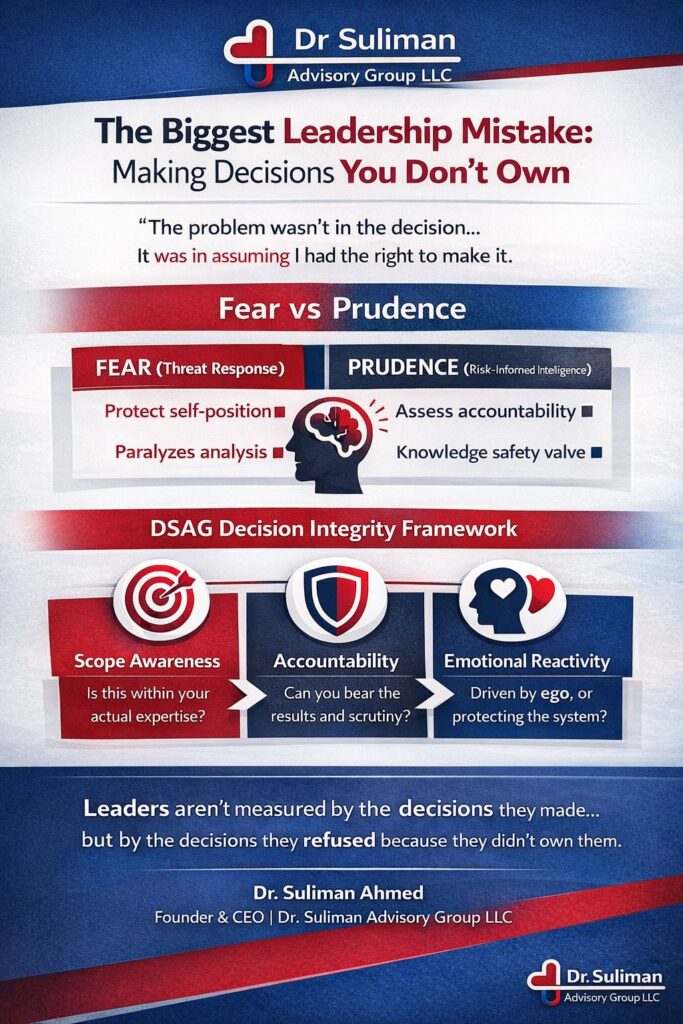
The problem was assuming I had the right to make it.
Later, that position was formally validated when the consultant refused to assign me the task and confirmed that responsibility belonged to the physician directly managing the case.
Decision Is Not Action. It Is Governance.
At Dr. Suliman Advisory Group, we believe decision-making is not an isolated action.
It is a governance commitment.
Leadership is not proven by speed.
It is proven by clarity.
Not by how quickly a person acts,
but by how clearly they understand what belongs to them, and what does not.
This is what I call:
Decision Governance Under Uncertainty
Making decisions within the boundaries of authority, accountability, and professional ownership.
Fear vs. Prudence
The Leadership Distinction Most People Misunderstand
One of the most common leadership failures is confusing informed caution with weakness.
This is where poor leaders judge quickly, and strong leaders think differently.
Fear (Threat Response)
Fear is emotional self-protection.
It protects position.
It protects ego.
It protects comfort.
It interrupts analysis and weakens judgment.
Fear reacts.
Prudence (Risk-Informed Intelligence)
Prudence is not hesitation.
Prudence is executive discipline.
It is disciplined awareness built through knowledge, responsibility, and consequence management.
It does not avoid decisions.
It protects the system from unnecessary damage.
Prudence is not weakness.
It is quality control for leadership.
The DSAG Decision Integrity Framework
Decision Integrity = (Scope Awareness × Accountability × Consequence Awareness) – Emotional Reactivity
Most leadership failures begin where one of these variables is ignored.
Scope Awareness
Does this decision fall within your actual professional authority?
Accountability
Do you hold both the authority and the willingness to carry its consequences?
Consequence Awareness
Do you understand the long-term systemic impact, not just the immediate outcome?
Emotional Reactivity
Are you acting to protect the system, or simply to protect your ego?
An Operational Reality Many Leaders Ignore
Courage is not always found in making decisions.
Sometimes, real leadership is refusing a decision you were never supposed to own.
The most dangerous decisions are not the wrong ones.
They are the ones you had no right to make in the first place.
Executive Application
Where this appears in real organizations
- A healthcare CEO approves a compliance pathway without legal authority
- A founder signs partnership terms without governance review
- A physician leader accepts responsibility without operational control
- A department director makes hiring decisions without budget ownership
Final Reflection
Fear may delay progress.
Prudence prevents damage.
Fear protects position.
Prudence protects credibility.
Fear is temporary.
Prudence builds trust that lasts.
Leaders are not measured by the number of decisions they make.
They are measured by the number of decisions they refuse because those decisions were never theirs to own.
Governance failures rarely begin with bad intentions.
They begin with unclear ownership.
Most organizations do not fail from lack of ambition. They fail from unclear ownership.
If your organization is navigating decisions that extend beyond daily operations, this is exactly where we work.
At Dr. Suliman Advisory Group, we help healthcare leaders and organizations design governance-first decisions built on accountability, strategic clarity, and long-term operational integrity.
For deeper strategic insights and full executive frameworks, follow The Advisory Pulse, where DSAG Leadership Doctrines are explored in full.
Because leadership is not about making more decisions.