
HPT = Analyzer + Operator + Developer + Marketer + Researcher
By: Dr. Suliman Ahmed
High performance is not accidental. It appears when an organization activates the five essential functional roles that every system must have. These roles do not need to be assigned to five different individuals, but each function must be present and consistently active.
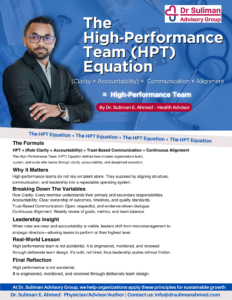
High-Performance Team = Analyzer + Operator + Developer + Marketer + Researcher
When these five functions work together in alignment, a team becomes capable of exceptional, sustained performance regardless of size or resources.
1. The Five Functional Roles: Definitions and Measurable Outputs
Analyzer
Core function: Provides high-level evaluation of organizational systems, identifies strategic and operational gaps, and ensures quality, compliance, and risk alignment.
Output: Monthly Quality and Compliance Dashboard, Quarterly Strategic Gap Analysis Report.
Operator
Core function: Strengthens execution by refining processes, improving efficiency, and stabilizing workflow.
Output: Process Efficiency Rate, Weekly Bottleneck Report.
Developer
Core function: Builds internal capabilities, expands services, and enhances team growth.
Output: New Capability Implementation Rate, Quarterly Skills Gap Training Plan.
Marketer
Core function: Shapes clear messaging, communicates organizational value, and positions the brand.
Output: Message Clarity Score, Quarterly Brand Positioning Update.
Researcher
Core function: Provides insight, supports evidence-based strategy, and strengthens organizational decision-making.
Output: Competitive Intelligence Briefing, Strategic Risk and Opportunity Analysis.
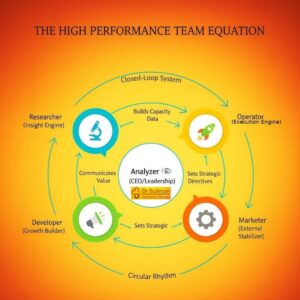
The High-Performance Team Closed-Loop Operating System
2. The Three-Step Process for Implementing the High-Performance Team Equation
Step 1: Diagnose the Current Structure
Assess how your organization allocates effort among the five roles. Assign 100 points across the roles to uncover imbalances.
In the first quarter of our operating year, DSAG allocated nearly half of its effort to operational execution, with less-than-targeted emphasis on analytical refinement. While execution was strong, this imbalance introduced avoidable gaps in completeness. We have since realigned our focus, dedicating 50% of effort to Research & Intellectual Capital (30%) and Quality Assurance & Compliance (20%). This adjustment ensures our work remains evidence-based, well-structured, and delivered at a consistently high professional standard.
Step 2: Assign Responsibilities with Clarity
Determine who holds primary and secondary responsibility for each role. One individual may cover more than one function, particularly in the early stages. What matters most is clarity of accountability.
At DSAG:
- I initially assumed primary responsibility for the Analyzer and Marketer roles.
- My co-founder served as a critical second line of oversight, leading the first established Internal Auditing Office and ensuring delivery aligned with my primary objective as a physician—bringing meticulous attention to accuracy, timing, and detail.
- Our account manager and international expert operated primarily as the Operator and Developer, while also coordinating execution.
- Contributing physicians supported both Developer and Researcher roles based on their clinical and academic expertise.
- The Independent Directing Advisory Board (IDAB) functioned as strategic Analyzers and insight Developers, each contributing according to their subject-matter expertise.
This structure operated in a closed-loop, circular rhythm, similar to a CPR team in medicine; each role contributing within its scope, while the Analyzer (CEO) continuously leads, corrects, and refines the process.
Step 3: Sustain the Structure Through a Weekly Alignment Check
Each week, every role reports a defined key metric. A weak or missing metric immediately signals a structural risk requiring leadership attention. Because DSAG’s operating workflow is clearly assigned and largely automated, approximately 90% of researcher deliverables are completed within the expected timeframe. The remaining cases are promptly followed up and resolved by the account manager. This structure allows the CEO to focus on high-level strategic planning and collective systems thinking. Given this operational maturity and accountability, the account manager was formally designated as the de facto Chief Operating Officer (COO) of the firm.
2. Communication Through the Stages of Group Development (McGraw-Hill, 2024)
Forming: Clarity
High performance begins with structure and clear communication. During the forming stage, I established DSAG’s mission, organizational design, and individual roles after benchmarking leading consultancy models. Team members were selected through a highly competitive process: from an initial pool of 60 physician candidates, only the top 5% were shortlisted following rigorous screening and testing. These selected members were then formally introduced to our Operating Body and Independent Directing Advisory Board through a structured onboarding process that emphasized expectations, accountability, and alignment from the outset.
Storming: Transparency
Challenges are expected. To manage them, we introduced the DSAG Three-Question Debrief:
- What was the intent
- What was the impact
- What is the systemic solution
All policies were consolidated in a Governance Hub to ensure clarity and prevent misalignment.
Norming: Collaboration
As alignment strengthened, communication became more collaborative. We encouraged open dialogue, cross-functional teamwork, and structured project debriefs to support shared accountability.
Performing: Strategic Oversight
At this stage, the team operates with stability and independence. My role as the founder & CEO shifts toward reinforcing long-term vision and ensuring strategic alignment.
4. Barriers to Team Effectiveness and DSAG’s Solutions
Miscommunication
We apply the “Flesh Out the Ghost” rule. Any discussion that results in a decision or policy must be documented, dated, and stored in the Governance Hub.
Unequal or Unrecognized Participation
The Weekly Alignment Check ensures that responsibilities are visible, measured, and acknowledged.
Lack of Cohesion
We revisit our mission during monthly all-hands meetings to reinforce unity and maintain forward momentum.
5. The Power of Collaboration: A Personal Reflection
When I founded DSAG, I quickly recognized that collective strength exceeds individual capability. Each member contributed unique expertise in business strategy, clinical insight, research, and advisory leadership. Working together strengthened our workflows, amplified our progress, and expanded our impact.
High performance is not a concept. It is a structure. When leaders define the system and activate the five essential roles, they create clarity, alignment, and sustainable momentum. This is the foundation on which DSAG was built, and it is a model any organization can use to elevate its performance.
Dr. Suliman E. Ahmed, M.D.
Founder and CEO, Dr. Suliman Advisory Group LLC